



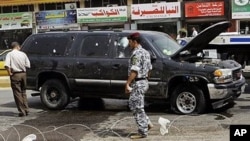
The top U.S. commander in Baghdad says Iraq's prolonged political crisis has encouraged militants to step up attacks and left civilians reluctant to divulge crucial information about insurgent cells.
Brigadier General Ralph Baker said Wednesday the recent spike in violence has included rocket strikes by Shi'ite militias and targeted killings by Sunni hit squads.
The U.S. military says at least 21 rocket attacks have occurred in Baghdad in the last month, most coming from the Shi'ite stronghold of Sadr City. The Iraqi capital's heavily fortified Green Zone has come under a particularly intense barrage of fire in recent weeks.
Two rockets fired at the Green Zone Wednesday came from predominantly Shi'ite neighborhoods.
General Baker and other U.S. commanders blamed Iran for training and equipping Shi'ite extremist groups and said the attacks are likely designed to discredit Prime Minister Nouri al-Maliki's claims that his government can protect the population from insurgent violence.
Anti-American cleric Moqtada al-Sadr's political group is locked in an intra-Shi'ite power struggle and opposes Mr. Maliki's election to a second term in office.
The Sadrists have joined the new National Alliance, a merger of Mr. Maliki's State of Law coalition and the Iran-friendly Iraqi National Alliance. The group missed a self-imposed deadline Monday to select a unified nominee for prime minister.
Sunni insurgents have been blamed for a string of targeted slayings since September 19, when bombings claimed by the group al-Qaida in Iraq killed more than 30 people in Baghdad.
Baker said al-Qaida and allied groups are trying to exploit the current political vacuum in Iraq by intimidating the public and creating "the perception that the Iraqi security forces are weak or ineffectual."
The U.S. general said Iraq's political impasse and increasing levels of violence have resulted in waning confidence among Iraqis, who are now less willing to share information about insurgents.
In northern Iraq, a suicide bomber detonated his explosives prematurely Wednesday in an area northeast of Suleimaniya, wounding two Kurdish (peshmerga) soldiers.
Some information for this report was provided by AP and AFP.