



CAPITOL HILL —
America’s collective horror over gun violence has not forged an overwhelming consensus on how to curb the bloodshed - a fact illustrated by a contentious hearing at the U.S. Capitol. The Senate Judiciary Committee heard starkly divergent views from impassioned advocates in the debate over gun control.
Mass slaughters of children in Connecticut, movie-goers in Colorado, college students in Virginia, and congressional constituents in Arizona have amplified calls for action.
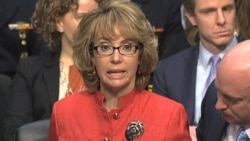
First to speak at the hearing: former Congresswoman Gabrielle Giffords, who was shot in the head during the 2011 Arizona shooting rampage.
“We must do something. It will be hard, but the time is now. You must act," she said.
Gun control advocates want to ban military-style assault weapons, limit the size of ammunition magazines, and require background checks for all gun purchases.
Baltimore County Police Chief James Johnson said, "Allowing 40 percent of those acquiring guns to bypass checks is like allowing 40 percent of passengers to board a plane without going through security. Would we do that?”
But gun rights defenders say new firearms regulations and restrictions are not the answer.
Wayne LaPierre, who heads the National Rifle Association, said, “Proposing more gun laws while failing to enforce the thousands we already have is not a serious solution for reducing crime. Nor do we believe that government should dictate what we can lawfully own and use to protect our families.”
At times, the hearing dissolved into chaos.
Some argued a balance must be struck: preserving the right of Americans’ to bear arms while ensuring public safety.
Democratic Senator Patrick Leahy said, “Lives are at risk when responsible people fail to stand up for laws that keep guns out of the hands of those who use them to commit murder, especially mass-murders.”
Others fear Congress will react impulsively to the Connecticut school shootings.
Republican Senator Ted Cruz said, “Unfortunately, in Washington, emotion often leads to bad policies.”
Passionate views exchanged at the hearing mirror deep divisions across the nation on firearms. Analyst Anthony Cordesman sees a bumpy road ahead in the gun control debate.
“This will be very political, extremely polarized. Public opinion will remain confused and divided, swinging up and down depending on who manipulates it best," he said.
The nation’s attention has been focused on gun violence since the tragedy at Newtown. All sides of the debate are keenly aware that another mass shooting could occur at any moment.