


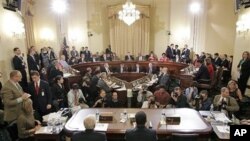
Emotions ran high at a congressional hearing Thursday on the extent of radicalization in the U.S. Muslim community. The hearing has reignited a national debate on how best to fight domestic terrorism while respecting Americans' civil liberties and religious diversity in the country.
Peter King, chairman of the House of Representatives Committee on Homeland Security, defended the hearing and its focus on the radicalization of the American Muslim community.
King, a Republican from New York, said there is nothing discriminatory about his approach, contrary to the objections of its many opponents.
"This committee cannot live in denial, which is what some of us would do when they suggest that this hearing dilute its focus by investigating threats unrelated to al-Qaida," said King. "The Department of Homeland Security and this committee were formed in response to the al-Qaida attacks of September 11th. There is no equivalency of threat between al-Qaida and neo-Nazis, environmental extremists or other isolated madmen."
Related video report by Carolyn Presutti
Civil rights and Muslim advocacy groups as well as a coalition of Christian and Jewish leaders have strongly criticized the hearing for focusing on the community of some seven million American Muslims, instead of looking at the broad spectrum of domestic terrorist groups that would include violent anti-government activists and white supremacists.
Democratic Representative Keith Ellison of Minnesota, the first Muslim American elected to the U.S. Congress, was a witness at the hearing and an opponent of its format.
"As leaders, we need to be rigorous about our analysis of violent extremism," said Ellison. "Our responsibility includes doing no harm. I am concerned that the focus of today's hearing may increase suspicion of the Muslim American community, ultimately making us all a little less safe."
Ellison sobbed when he related the story of a young Muslim American who gave his life as a first responder after the 2001 terrorist attacks on the Untied States, saying there were hateful and false rumors after his death that he might have been involved in the attacks because he was Muslim.
Two of the witnesses at the hearing had family members who were radicalized by Islamist extremists. Melvin Bledsoe of Tennessee told the story of his son, Carlos Bledsoe, who converted to Islam at age 19 and was radicalized in the United States. The young man traveled to Yemen and was trained in a terrorist training camp. He later shot and killed a U.S. Army private and wounded another outside an army recruiting station. Bledsoe is in jail, facing murder charges. His father said he wants to warn other American parents that radicalization is a gradual process.
"If I can save one other child from going through what my family has gone through or the victim's family went through, then I think my trip here to this committee was worthwhile," said Bledsoe.
The subject of Islamic radicalization and terrorism divided the House committee largely along party lines. Most Democratic members objected to the hearing's focus on one religious group.
Democratic Representative Laura Richardson of California was blunt in her assessment of Republican committee Chairman Peter King.
"It believe the narrow scope of this hearing is discriminatory and it is an abuse of power," said Richardson.
Most Republican members commended King for being steadfast in the face of opposition to the hearing.
Los Angeles Sheriff Leroy Baca, who testified before the committee, appeared at some points to be caught in the middle, with lawmakers from both major parties seeking his agreement with their position.
Baca spoke from a law enforcement perspective, saying it is his job to protect Americans of all faiths and from all walks of life, and that police need public participation from everyone.
"The Muslim community is no less or no more important than others as no one can predict with complete accuracy who and what will pose the next threat against our nation," said Baca.
Baca said his experience has been that American Muslims increasingly are gaining confidence in cooperating with law enforcement officials.
Senior Obama administration officials say that the threat of domestic terrorism is real, but they stress that the answer is to reach out to the Muslim American community and not to stigmatize an entire group because of the actions of a few.
Representative King vows to hold more hearings on the radicalization of American Muslims, saying he is driven by the desire to prevent another al-Qaida attack on the United States.
Radicalization in the U.S. Muslim Community, Organizations Panel Hearing