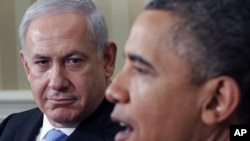
At the White House, U.S. President Barack Obama and Israeli Prime Minister Benjamin Netanyahu have held talks on the troubled Israeli-Palestinian peace process. The two leaders issued statements masking what were likely contentious discussions.
The talks came a day after President Obama, in a major policy address on the Middle East, endorsed a solution to the Israeli-Palestinian conflict based on lines existing before the 1967 Six Day War.
Obama said this must be accompanied by mutually agreed land swaps to ensure secure and recognized borders for both states under any future agreement.
Basing an eventual solution on 1967 borders has long been a U.S. position, shared by international partners, but Mr. Netanyahu reacted angrily to Obama's high-profile endorsement of it as a starting point for resuming negotiations.
After about a 90-minute delay following intense talks, President Obama and Prime Minister Netanyahu issued statements to reporters.
Calling their discussions "extremely constructive," Obama said it is possible to shape a deal that allows Israel to secure itself, but also allows it to resolve what he called "a wrenching issue" for both peoples for decades.
But referring to the unity accord between Fatah and Hamas, Obama said he agreed it will be very difficult for Israel to negotiate "in a serious way" with a party that refuses to acknowledge Israel's right to exist.
"Hamas has been, and is an organization that has resorted to terror, that has refused to acknowledge Israel's right to exist, it is not a partner for a significant, realistic peace process," said President Obama. "And so as I said yesterday in the speech, Palestinians are going to have to explain how they can credibly engage in serious peace negotiations in the absence of observing the Quartet principles that have been put forward previously."
Hamas, which controls Gaza and is linked to the Palestinian Authority in a unity accord, has called the president's proposals a "total failure," saying the group will not recognize Israel's occupation under any circumstances."
Netanyahu said Israel wants, and would make "generous compromises" for peace, but one based on "basic realities." He rejected any settlement based on 1967 borders, calling such lines "indefensible," and made clear Israel will not negotiate with a Palestinian government that includes Hamas.
"Hamas has just attacked you, Mr. President, and the United States, for ridding the world of [Osama] bin Laden," said Prime Minister Netanyahu. "So Israel obviously cannot be asked to negotiate with a government that is backed by the Palestinian version of al-Qaida. I think President [Mahmoud] Abbas has a simple choice. He has to decide if he negotiates or keeps his pact with Hamas or makes peace with Israel."
Netanyahu said the Palestinian refugee issue will have to be resolved in the context of a Palestinian state, but "certainly not in the borders of Israel."
The Israeli leader said while there are differences "here and there," there is what he called an overall direction for the U.S. and Israel to pursue what he called a "peace that is defensible" between Israel and Palestinians.
President Obama said he and Netanyahu also discussed changes sweeping the Middle East, and agreed there is a moment of opportunity that can be seized as a consequence of the Arab Spring, but acknowledged there are significant perils as well.
The president said he provided additional details to Netanyahu about U.S. efforts to pressure Syrian President Bashar al-Assad on political reform, and reiterated the U.S. position that it would be unacceptable for Iran to possess a nuclear weapon.