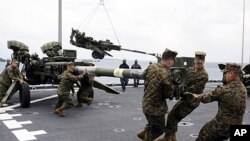



The two sides appear headed toward canceling a 2006 accord to relocate a US military facility.
2006 accord, not implemented
Japan and the United States appear to be heading toward canceling a 2006 accord that would have relocated a strategic American military facility to a less crowded part of the island of Okinawa. This comes as the city at the heart of the base controversy has elected a new mayor.
Impeded by activists and local politicians who want U.S.military bases and their personnel moved off Okinawa instead of relocated to other parts of the island, influential Japanese officials, according to sources, are concluding the agreed-to plan with Washington will not be implemented.
That would mean the Futenma Marine Corps Air Station remains operational in the middle of the heavily congested city of Ginowan.
Newly elected mayor, appeal for resolution
On Sunday, voters in Ginowan elected Atsushi Sakima as their new mayor.
Cheers of “banzai” erupted in Sakima's campaign headquarters when word came he was assured victory over a leftist anti-base hardliner. But Sakima also campaigned on a pledge to have the Marine air station removed from the island.
He reiterated that stance to reporters in his first comments as mayor-elect. Sakima said, along with Okinawa's governor, he wants to appeal to the central government for resolution of the issue of the air station and moving the Marines to reduce the burden on the local population.
De-linking relocation of air station from marine movement
Media reports last week said some U.S. Marines based on Okinawa, numbering about 1,500, would move to the Japanese mainland. But the former U.S. consul general on Okinawa, Kevin Maher, said there are no signs that is being seriously considered.
“I have been told by people both in the Japanese and the U.S.governments that the idea of moving some number of Marines to mainland Japan, to Iwakuni specifically, is not something that is being discussed by the governments," he said.
They would be part of around 8,000 Marines, originally scheduled to move from Okinawa to Guam, based on the six-year-old agreement on realignment of American forces in Japan.
The United States and Japan jointly announced last week they are de-linking the relocation of the air station from the movement of the Marines from the island.
Maher, now a consultant, said the Japanese government has failed to explain to the Okinawans why the U.S. bases are vital. The former head of the State Department's Japan office contends the bases are critical not only for Japan's security, but Okinawa's as well, especially at a time when China is quickly expanding its blue water naval capabilities.
“A lot of that is aimed at the southwest islands of Japan, the Ryukyu islands. If you look at the first island chain strategy of the Chinese that includes the islands of Okinawa, the Chinese strategy of area access and denial very directly impacts the islands of Okinawa. So the Okinawans just have to understand that they are in a situation and a location that is strategic," he said.
Okinawa hosts nearly half of the 50,000 U.S. military personnel stationed in Japan, including 18,000 Marines.
Maher retired from government service last year, after alleged controversial remarks about Okinawans attributed to him were published by a Japanese news agency. Maher has denied that he made any offensive comments during an off-the-record briefing to university students in Washington.
US-Japan May Scrap Accord on Marines in Okinawa