


Analysts say the Pentagon's recent announcement that it is working with Japan to counter any Chinese military action to seize disputed islands in the East China Sea is a surprisingly blunt warning to Beijing.
A U.S. defense official on Wednesday said the chief of the Japanese Self-Defense Forces Joint Staff, General Shigeru Iwasaki, will meet later this week with the head of the U.S. Pacific Command, Admiral Samuel Locklear, to discuss a plan to retake the islands Japan calls the Senkaku, should China invade. It confirmed an earlier report by Japan's Nikkei newspaper.
Washington officials have repeatedly reaffirmed the islands fall under an American defense pact with Japan that obliges the United States to aid Tokyo in the event of an attack. But, they have been careful not to anger Beijing, insisting the U.S. does not take a position on the sovereignty of the islands, called the Diaoyu by China.
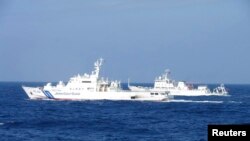
In recent months, China has conducted almost-daily maritime patrols around the Japanese-controlled islands, leading some analysts to believe it is trying to establish a new status quo in the strategic, energy-rich area. Both countries have also scrambled fighter jets to the area, raising fears of a military clash.
Mohan Malik, a professor of Asian security at the Hawaii-based Asia-Pacific Center for Security Studies, says the Pentagon's announcement is aimed at deterring China from further escalating the dispute.
"The Chinese are trying to challenge Japan's control of the islands through the deployment of civilian maritime surveillance vessels. They believe this will weaken Japan's control of the islands and reinforce China's sovereignty claims," said Malik.
Malik says the United States is also worried Japan may overreact to the Chinese patrols. He says the Pentagon's announcement is meant to reassure Japanese officials, who have long wanted explicit statements of support on the island issue.
"They want the U.S. to make unequivocal statements in support of Japan's claims, which has been done at the diplomatic level. But obviously, they want some sort of military demonstration of this commitment and this should be viewed as part of that," he said.
John Blaxland, a senior fellow at the Australian National University's Strategic and Defense Center, says is not surprised that the U.S. is discussing contingency plans with Japan.
"But what is surprising is the fact that it's being leaked to the media," he said. "The fact that a Pentagon official is saying that we're planning [to retake the islands] is, in itself, a significant turn of events. And, it speaks to what appears to be a deliberate attempt to convey a strong message to China about the Senkaku/Diaoyu Islands."
On Thursday, China said it was "gravely concerned" at the reports of the U.S.-Japan talks. Foreign Ministry spokesperson Hong Lei said "no outside pressure" would shake Beijing's determination to defend its "national territorial sovereignty." Earlier, China's Defense Ministry said it firmly opposes "any action that could further complicate and magnify the situation."
For decades, China and Japan have quarreled about the tiny, uninhabited islands. They are surrounded by rich fishing grounds and a strategic shipping area. The conflict has escalated in recent years, after surveys suggested there were oil reserves in the area.
Victor Beattie contributed to this report.
A U.S. defense official on Wednesday said the chief of the Japanese Self-Defense Forces Joint Staff, General Shigeru Iwasaki, will meet later this week with the head of the U.S. Pacific Command, Admiral Samuel Locklear, to discuss a plan to retake the islands Japan calls the Senkaku, should China invade. It confirmed an earlier report by Japan's Nikkei newspaper.
Washington officials have repeatedly reaffirmed the islands fall under an American defense pact with Japan that obliges the United States to aid Tokyo in the event of an attack. But, they have been careful not to anger Beijing, insisting the U.S. does not take a position on the sovereignty of the islands, called the Diaoyu by China.
In recent months, China has conducted almost-daily maritime patrols around the Japanese-controlled islands, leading some analysts to believe it is trying to establish a new status quo in the strategic, energy-rich area. Both countries have also scrambled fighter jets to the area, raising fears of a military clash.
Mohan Malik, a professor of Asian security at the Hawaii-based Asia-Pacific Center for Security Studies, says the Pentagon's announcement is aimed at deterring China from further escalating the dispute.
"The Chinese are trying to challenge Japan's control of the islands through the deployment of civilian maritime surveillance vessels. They believe this will weaken Japan's control of the islands and reinforce China's sovereignty claims," said Malik.
Malik says the United States is also worried Japan may overreact to the Chinese patrols. He says the Pentagon's announcement is meant to reassure Japanese officials, who have long wanted explicit statements of support on the island issue.
"They want the U.S. to make unequivocal statements in support of Japan's claims, which has been done at the diplomatic level. But obviously, they want some sort of military demonstration of this commitment and this should be viewed as part of that," he said.
John Blaxland, a senior fellow at the Australian National University's Strategic and Defense Center, says is not surprised that the U.S. is discussing contingency plans with Japan.
"But what is surprising is the fact that it's being leaked to the media," he said. "The fact that a Pentagon official is saying that we're planning [to retake the islands] is, in itself, a significant turn of events. And, it speaks to what appears to be a deliberate attempt to convey a strong message to China about the Senkaku/Diaoyu Islands."
On Thursday, China said it was "gravely concerned" at the reports of the U.S.-Japan talks. Foreign Ministry spokesperson Hong Lei said "no outside pressure" would shake Beijing's determination to defend its "national territorial sovereignty." Earlier, China's Defense Ministry said it firmly opposes "any action that could further complicate and magnify the situation."
For decades, China and Japan have quarreled about the tiny, uninhabited islands. They are surrounded by rich fishing grounds and a strategic shipping area. The conflict has escalated in recent years, after surveys suggested there were oil reserves in the area.
Victor Beattie contributed to this report.