


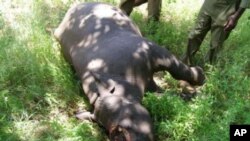
The survival of elephants and rhinoceroses in Africa is being threatened by poaching - a multi-billion dollar illegal industry that helps bankroll militias in conflict zones and places local civilian populations at great risk. That was the message experts delivered to U.S. lawmakers, along with a plea for urgent action.
With every passing year, more carcasses of Africa’s biggest animals are left to rot - a trail of death stretching from Kenya to South Africa. Taking note is the U.S. Senate Foreign Relations Committee, which held a hearing on the topic Thursday. Committee chairman John Kerry:
“How shockingly destructive and historically shameful it would be if we did nothing while a great species was criminally slaughtered into extinction," said Kerry.
Asian demand for ivory and human greed are to blame, according to John Scanlon, who heads the Geneva-based Convention on International Trade in Endangered Species, known as CITES.
“There are very high profits to be made," said Scanlon. "With respect to Rhino horn, the latest estimate we have is the black market price has gone up to $65,000 a kilogram. That is way above the price of gold.”
And concerns extend well beyond the fate of animals, according to Tom Cardamone, an expert on illegal financial flows.
“Organized crime syndicates, militias, and even terrorist elements have taken notice of the profits that can be made in wildlife trafficking, generating an alarming uptick in the scale of the industry, and posing serious national security concerns for the U.S. and our partners," said Cardamone.
Experts urged a redoubling of efforts to protect endangered wildlife, prosecute and imprison poachers, and halt Asian demand for ivory. Iain Douglas-Hamilton is founder of the conservation group “Save the Elephants”:
“The Chinese highly value their own wild elephants, and they are strictly protected," said Douglas-Hamilton. "If China would develop a leadership role in Africa, as well as in her own country with respect to elephants, much of the problem could be solved. If the buying [of ivory] stops, the killing can, too.”
And time is running short, according to Senator Kerry.
“If we do not act now, then the time will come too late," he said.
2011 saw record ivory seizures in Africa. Experts expect even greater seizures this year - evidence of a slaughter that continues unabated.
With every passing year, more carcasses of Africa’s biggest animals are left to rot - a trail of death stretching from Kenya to South Africa. Taking note is the U.S. Senate Foreign Relations Committee, which held a hearing on the topic Thursday. Committee chairman John Kerry:
“How shockingly destructive and historically shameful it would be if we did nothing while a great species was criminally slaughtered into extinction," said Kerry.
Asian demand for ivory and human greed are to blame, according to John Scanlon, who heads the Geneva-based Convention on International Trade in Endangered Species, known as CITES.
“There are very high profits to be made," said Scanlon. "With respect to Rhino horn, the latest estimate we have is the black market price has gone up to $65,000 a kilogram. That is way above the price of gold.”
And concerns extend well beyond the fate of animals, according to Tom Cardamone, an expert on illegal financial flows.
“Organized crime syndicates, militias, and even terrorist elements have taken notice of the profits that can be made in wildlife trafficking, generating an alarming uptick in the scale of the industry, and posing serious national security concerns for the U.S. and our partners," said Cardamone.
Experts urged a redoubling of efforts to protect endangered wildlife, prosecute and imprison poachers, and halt Asian demand for ivory. Iain Douglas-Hamilton is founder of the conservation group “Save the Elephants”:
“The Chinese highly value their own wild elephants, and they are strictly protected," said Douglas-Hamilton. "If China would develop a leadership role in Africa, as well as in her own country with respect to elephants, much of the problem could be solved. If the buying [of ivory] stops, the killing can, too.”
And time is running short, according to Senator Kerry.
“If we do not act now, then the time will come too late," he said.
2011 saw record ivory seizures in Africa. Experts expect even greater seizures this year - evidence of a slaughter that continues unabated.