



U.S. lawmakers are urging the Obama administration to find new ways to persuade North Korea to change its behavior and end what they say is a "cycle of provocation." Talks on ending North Korea's nuclear weapons program have been stalled for more than two years and many analysts say that last year was the most dangerous on the Korean Peninsula since the Korean War.
During the past year, Pyongyang has launched two military attacks on South Korea - sinking a military ship last March and shelling a South Korean island. It also revealed a uranium enrichment program that could provide North Korea with material for nuclear weapons.
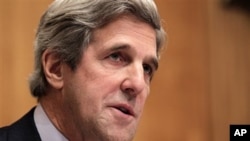
The chairman of the U.S. Senate Foreign Relations Committee, Democrat John Kerry of Connecticut, says the risks of maintaining the status quo toward North Korea are grave.
"North Korea is simply going to build more nuclear weapons and missiles," said Kerry. "It may well export nuclear technology, even fissile material. And the next violation of the armistice could easily escalate into wider hostilities that threaten U.S. allies and interests."
Kerry spoke Tuesday during a Foreign Relations Committee hearing on North Korea. He said that although the world is focused on events sweeping the Arab world or their impact on U.S. foreign policy, North Korea is also a pressing concern.
"So far, international initiatives have not stabilized the situation, much less brought about a change of course in North Korea," he said.
The Ranking Republican on the Foreign Relations Committee, Richard Lugar of Indiana, said that although the Obama administration has worked closely with Seoul to respond to Pyongyang's provocations, its strategy for ending North Korea's nuclear weapons program is unclear.
Lugar said more needs to be done to stop North Korean nuclear proliferation.
"The risk that sensitive nuclear technology, weapons components or even weapons themselves might be transferred out of North Korea for geopolitical objectives or personal profit is an equal if not greater threat than North Korea's missile capability," said Lugar.
Lugar noted that North Korea has a network of more than 200 companies supporting it in its efforts to obtain military technologies and that reports suggest the network is being used to transfer nuclear technology.
The top U.S. diplomat for East Asia, Kurt Campbell, and U.S. Special Envoy to North Korea Stephen Bosworth echoed the committee's concern about North Korean nuclear proliferation.
Campbell testified that although more needs to be done, the United States has had some successes in curbing North Korean proliferation.
"In the last year, a number of states who had previously never been involved in, shall we say interdicting, and helping us with the transfer of illicit cargos from North Korea to sites either in Asia or in the Middle East have assisted us in turning back shipments," said Campbell.
But Bosworth and Campbell stressed that for talks with North Korea to resume, Pyongyang needs first show its commitment to improving relations with Seoul, take irreversible steps to denuclearize and end its provocations.
Bosworth told the senate panel that the United States is ready to talk with North Korea and is considering resuming food aid, following reports that a severe food shortage there could lead to malnutrition and starvation.
"We do separate humanitarian assistance from political issues," said Bosworth. "But we provide food aid when we see a perceived need and in a situation in which we can monitor how the food aid is used, who are the recipients of that food aid and does it go to the people to whom we intend it."
The U.S. government suspended food aid to North Korea in 2009, after Pyongyang expelled monitors who were there to ensure the food reached those who needed it most. Pyongyang is suspected of diverting foreign assistance to support its huge military force.