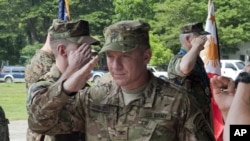
In the aftermath of the terrorist attacks of September 11, 2001, the U.S. dispatched a military team to the Philippines to help the Manila government root out militant Islamic extremist groups. The terrorist threat is seen as much diminished since then but still active. The military mission remains in the Philippines as part of the U.S.-led global anti-terrorism campaign.
Rocky Zeender spent two years on what he calls the “forgotten front” of the war on terrorism - the Philippines.
"Nobody knows about it. Right now all the funding and all the military support is going into the Middle East. And by no means is the Philippines as large of a front as the Middle East. However, it does provide an enormous safe haven for some radical members of the Moro Islamic Liberation Front or Abu Sayyaf and Jemaah Islamiyah to come and train in," Zeender said.
As a member of the U.S. Special Forces, a “Green Beret”, Zeender slogged through the jungles and across mountains of the southern Philippines with Philippine troops from 2008 to 2010 looking for militant Islamist groups, some of whom have had links to al-Qaida.
"You do have some very sporadic cities throughout Mindanao, although it would pretty much resemble any Vietnam movie anyone has ever watched - pretty much nothing but jungle and mountains and rice paddies. I spent most of my time up in the mountains. It was extremely dense jungle, extremely dense forest, very steep terrain, and very difficult to travel, sometimes impossible to travel, by vehicle, only by foot," Zeender said.
The Joint Special Operations Task Force-Philippines, numbering about 600 men and women from the four U.S. armed services with an annual $90 million budget in the current fiscal year, was created in 2002. Its mission, as the Task Force’s website puts it, is to advise and assist Philippine forces to fight terrorism and to deliver humanitarian assistance to the people of Mindanao.
The Joint Task Force’s presence is temporary and its role is strictly advisory. But Zeender says U.S. troops did patrol with military troops and national police, and in doing so did take casualties, including some fatalities, primarily from improvised explosive devices.
"The U.S. military is not allowed to actively target terrorist groups within the Philippines. We were there strictly as advisors. However, if attacked, we do obviously have the right to self-defense, and that did happen under a couple of occasions while I was in the Philippines. And we worked very well with our counterparts," Zeender said.
The vast and rugged Philippine archipelago along with the islands of Indonesia to the south is a perfect refuge for terrorist groups. The primary terrorist groups there are the Abu Sayyaf Group, a separatist group that has long utilized kidnapping for ransom to get funds and hostage beheadings to reinforce its demands, and Jemaah Islamiyah, an al-Qaida ally responsible for several deadly bombings in Indonesia and the Philippines. The Moro Islamic Liberation Front has officially broken with al-Qaida and has had a series of on-again, off-again ceasefires with the Philippine government as it tries to reach a peace settlement but radical members of the group remain militarily active.
Emile Nakhleh, former chief of the CIA’s political Islam strategic analysis unit, says the jihadist groups’ influence in the region is weakening.
"There are still some very nasty elements. But the countries in Southeast Asia and the publics have basically - especially their publics - are rejecting this whole rhetoric of terrorism and the whole radical narrative that has been the hallmark of global terrorism. And so they are definitely on the wane," Nakhleh said.
However, in January a bus bombing in Manila was blamed on the Abu Sayyaf. In June, Philippine security forces went on alert for possible terrorist bomb attacks in Manila. The attacks never materialized. But the island of Mindanao and the Sulu Archipelago remain dangerous. On July 12 two American citizens and a Filipino relative were kidnapped in Zamboanga City on Mindanao.
Zeender believes progress against Philippine-based terrorist groups remains elusive without a deeper U.S. commitment in the Philippines.
"We’ve lost some members of my old unit actually down there. And I don’t really see any gains being made. There seems to be one hand in the pot, and we’re not really fully committing. And I believe it would be almost kind of a stalemate. We’re not really gaining any ground or affecting anything on a large international level. However, we are helping the Philippine government and some of the locals. But on an international scale, as far as eliminating the threat of terror, we’re sort of stalemating it," Zeender said.
But the issue of a U.S. troop presence is a sensitive one in the Philippines. The 1987 Philippines constitution bars foreign military bases from the country, and the U.S. bases were closed after Philippine Congress voted in 1991 not to extend the base leases. However, the two countries still hold joint military exercises. And Secretary of State Hillary Clinton reaffirmed the U.S. defense commitment to the Philippines in June amid rising tensions between Manila and Beijing over disputed islands in the South China Sea.
US Maintains Quiet Counterterrorism Effort in Philippines