


Amid indications of continuing behind-the-scenes contacts with Pyongyang,, separately by Seoul and Washington, diplomats of both South Korea and the United States are comparing notes.
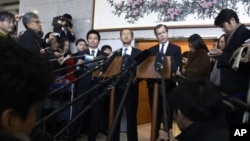
The U.S. special representative for North Korea policy, Glyn Davies, is in South Korea. He is accompanied by Clifford Hart, the envoy who would be the chief representative for Washington if six-nation talks with North Korea resume.
Davies and Hart met Thursday with South Korea's foreign minister, unification minister and its national security adviser.
The Americans, next week, are to hold talks about North Korea with Japanese and Chinese officials, respectively in Tokyo and Beijing.
The discussions center on trying to forge agreement among the two Koreas, the United States, China, Japan and Russia to resume the long-stalled six-nation talks on Pyongyang's nuclear weapons development. The formal talks are aimed at getting North Korea to give up its nuclear programs in exchange for substantial aid and improved diplomatic ties.
While the two countries have no diplomatic relations, Davies says communication between the U.S. government and North Korean diplomats, at Pyongyang's U.N. mission in New York, continue about a possible third round of exploratory talks.
"Those contacts with the North Koreans continue," he said. "I hope, at some point, in the not too distant future we will have an opportunity to get back to the table with them. But quite frankly we are not interested in talks for talk's sake."
The U.S. diplomat adds that North Korea needs to indicate it is prepared to take concrete steps - such as observing previous commitments and halting its uranium enrichment program - before Washington and Seoul can recommend a resumption of the six-nation discussions.
Davies also says Washington has told Pyongyang it encourages further North-South direct dialogue.
Seoul and Pyongyang have also held two rounds of meetings this year to see if there is common ground on the nuclear talks. And, there are fresh reports of additional and recent secret - but apparently futile talks - between the two Koreas, centering on humanitarian issues.
North Korean officials have said the nuclear talks must resume without pre-conditions. Frustration among North Korean government officials appears
to be growing.
An official of a North Korean-affiliated organization, with close contacts to the authorities in Pyongyang, recently told VOA, if the six-party talks have not resumed by the middle of next year, North Korea's military would feel compelled to "do something."
Analysts say North Korea has a history of instigating military and other provocations when its leadership has perceived diplomacy is not making progress. Past incidents have included two North Korean nuclear weapons tests, as well as ballistic or other missile launches.
But two American academics at Stanford University, Robert Carlin and John Lewis, say Chinese officials have told them Pyongyang has promised Beijing not to make fresh trouble in the short term. In exchange, according to a column by the academics in Thursday's Los Angeles Times, the Chinese have agreed to closer ties with North Korea, such as providing more economic help for the impoverished North Korean economy.
Meanwhile, there is growing concern about how close North Korea is to having a missile that can carry a nuclear weapon and strike other countries, not only South Korea and Japan, but as far away as the United States.
South Korea's point man on the nuclear issue, Ambassador Lim Sung-nam, standing alongside Davies on Thursday, expressed his government's concern.
Lim says Pyongyang's ballistic missile development is clearly a significant regional threat. However, he says he cannot comment on what Seoul and Washington know about the matter because it is sensitive intelligence information.
Three weeks ago, five Republican members of the U.S. House of Representatives' Armed Services Committee sent a letter to Defense Secretary Leon Panetta expressing concern about "new intelligence" on long-range ballistic missile development by foreign nations, notably North Korea.
The Washington Times, on Monday, reported the new intelligence is based on a classified intelligence briefing last month to members of Congress which mentioned progress North Korea is making with a road mobile inter-continental ballistic missile platform.
US Not Ruling Out More Talks with North Korea