US Postage Stamp Honors Rosa Parks on 100th Birthday
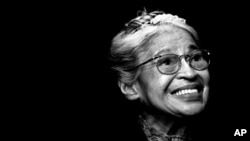
In this November 28, 1999 file photo, Rosa Parks smiles during a ceremony where she received the Congressional Medal of Freedom in Detroit.
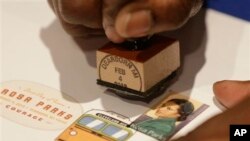
The U.S. Postal Service has issued a special Rosa Parks stamp to commemorate the 100th birthday of the late civil rights icon who helped end racial segregation in the United States.
A postal service employee prepares to cancel the Rosa Parks' 100th birthday commemorative postage stamp at The Henry Ford museum in Dearborn, Mich., Monday, Feb. 4, 2013.
The stamp shows an artist's depiction of a 1950s-era photo of Parks, who was arrested in 1955 for refusing to give up her seat to a white man on a Montgomery, Alabama bus.
At the time, blacks were treated as second-class citizens and regularly faced racism, discrimination and violence simply because of the color of their skin.
Parks' arrest sparked a 381-day boycott of the Montgomery bus system, nearly crippling the service because a majority of its riders were black.
The protest had more wide-ranging effects, too. It helped bring prominence to Reverend Martin Luther King Junior, who went on to become one of the country's most outspoken advocates of racial equality and civil rights.
The boycott ended when the Supreme Court banned segregation on public transportation in 1956 and ordered Montgomery to integrate its buses.
Of her historic decision to refuse to move to the back of the bus, where other black riders sat, Parks later said, "All I was doing was trying to get home from work."
The soft-spoken but feisty activist died in 2005 at the age of 92, becoming the first woman to lie in honor in the U.S. Capitol Rotunda.
Diagram of the Bus Showing Where Rosa Parks Was Seated:
This diagram shows where Rosa Parks was seated on a Montgomery, Alabama, bus on December 1, 1955. At that time, the front 10 seats of the Montgomery city buses were permanently reserved for white passengers. Parks was seated in the first row behind those 10 seats. When the bus became crowded, the bus driver instructed Parks and the other three passengers seated in that row, all African Americans, to vacate their seats for the white passengers boarding. Eventually, three of the passengers moved, while Parks remained seated. When Parks disobeyed the bus driver's request to move, he called the police. (Courtesy National Archives)