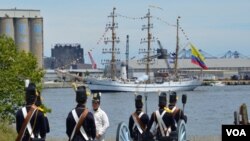
To kick off the 200th anniversary of the War of 1812, ships from around the world sailed past Fort McHenry and exchanged cannon fire with re-enactors on land, but it was all for show. (S. Logue/VOA)
The cannons firing today at Fort McHenry in the U.S. state of Maryland, are for the benefit of tourists. But that wasn’t the case nearly 200 years ago, when more than a dozen British ships bombarded the fort at the entrance to Baltimore harbor.
"It was pouring down rain. It was windy,” says Vincent Vaise, head historian for the fort. “Rockets [were] streaking over the fort, bombs exploding. You could hear the reverberations, the concussions around the fort.”
America's most famous struggle against the British occurred decades earlier during the War of Independence. Every Fourth of July Americans celebrate the Declaration of Independence, issued on July 4, 1776, which marked the beginning of the seven-year war.
The United States also waged another war against Britain during the War of 1812. Yet many Americans are unfamiliar with that conflict and its famous Battle of Baltimore. Now, as the United States marks the war's bicentennial, some historians, especially in Maryland, are eager to change that.
The Battle of Baltimore took place in 1814. The bombardment lasted 25 hours and was a turning point in the war that started two years earlier along the border with Canada.
“We thought they would love to be a part of the United States and throw off the yolk of English tyranny,” says Burt Kummerow, president of the Maryland Historical Society. “But when [the Americans] actually attacked the British armies up there, they found out very quickly the Canadians weren’t so interested in being grabbed.”
There were other reasons the U.S. declared war on Britain. The British Navy was intercepting American vessels and seizing crew members to man its warships.
Baltimore, in particular, was a target, “because Baltimore had a big reputation for being a real thorn in the side of the British merchant fleet," Kummerow says. "They were sending out privateers, because this was a great shipbuilding area. They were attacking the British.”
On September 13, 1814, British ships attacked Fort McHenry in a bid to take the city.
That battle is remembered largely thanks to Francis Scott Key, an American lawyer, who was down river observing the action through a spy glass, as the sun began to rise.
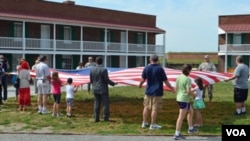
It’s all about the flag at Fort McHenry in Maryland, where every day visitors unfold a large “star-spangled banner” as they listen to the story behind the US national anthem. (S. Logue/VOA)
“He wasn’t sure who won the fight, and then he sees the huge flag waving over the fort, it was like, ‘Yes!’" Vaise says. "And he realizes that a powerful morale victory had been won, and he will write the words that became ‘The Star Spangled Banner.’”
Key’s handwritten homage to the national flag is on display at the Maryland Historical Society. “He wrote lyrics to a song. It wasn’t a poem; it was a song,” Kummerow says.
The tune had been around for 40 years, and was popular. When paired with Key’s lyrics, Kummerow says, “It went viral.”
In 1931, when Congress decided the United States should have a national anthem, “The Star Spangled Banner” was chosen.
Tourists come to Fort McHenry to hear the story behind the national anthem, but Vaise hopes they leave understanding another legacy of the war.
“We were no longer that former colony," he says. "We were this young and up-and-coming nation that was on the rise."
And the Star-Spangled Banner, both the flag and the anthem, became powerful, lasting symbols of that optimism.