


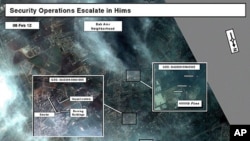
The Obama administration is releasing declassified images of Syrian military assaults against civilians, as part of efforts to rally international support against President Bashar al-Assad.
U.S. Ambassador Robert Ford is using his Facebook page to post declassified U.S. imagery of Syrian military attacks against civilians in the besieged city of Homs, where Assad opponents say government troops shelled the Baba Amr district for a seventh day.
U.S. State Department spokeswoman Victoria Nuland says the images include "very gruesome pictures” of tanks and fires, the kinds of things she says you only see when a major military assault is underway.
"Our intent here is to obviously expose the ruthlessness of the brutality of this regime and its overwhelming predominant advantage and the horrible kind of weaponry that it is deploying against its people," she said.
Nuland says Ambassador Ford, who left Damascus when Washington closed its embassy Monday, is also continuing to communicate with Syrians through his Twitter account.
Additional declassified images from Zabandani and Halboun are available at www.stateondemand.com.
In addition to social media and more traditional news outlets, Moscow and Beijing are also part of the intended audience for these images following their veto of a U.N. Security Council resolution backing Arab League action against President Assad.
Assistant Secretary of State for Near Eastern Affairs Jeff Feltman met Friday with Arab leaders in Bahrain after Thursday talks in Paris as part of efforts to rally international pressure against Damascus.
The group - to be called either the "Friends of a Democratic Syria" or the "Friends of a Syrian People" - is meant to provide humanitarian relief and political support for Assad opponents while increasing sanctions against Damascus and pressuring those who still provide military support to the Syrian army - chiefly Russia.
| Join the conversation on our social journalism site - Middle East Voices. Follow our Middle East reports on Twitter and discuss them on our Facebook page. |