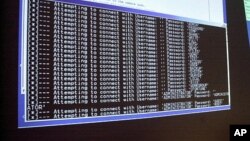
U.S. officials say hackers pose a threat to the nation's economy and accuse China of carrying out the most cyber-attacks.
The assessment is in a classified "National Intelligence Estimate" that officials described to U.S. media, including The Washington Post. A published report says hackers are targeting the energy, finance, information technology, aerospace and automotive sectors.
Some estimates put the cost to the U.S. economy at tens of billions of dollars each year. Brad Glosserman, executive director of the Hawaii-based Pacific Forum think tank, said it is difficult to identify the true sources of cyber espionage.
"Attacks have been on the rise without question," he said, explaining that, often, even experts can only guy where the attacks are coming from.
"As for the vulnerabilities to the financial sector, I would assume that's correct, but I would suggest that the vulnerabilities are throughout the U.S. economy," he added. "The problem is that many people do not like to speak about these things because either they're unaware they are being attacked or very reluctant to publicize their vulnerabilities."
The White House is considering responses to cyber-attacks, including trade actions and visa restrictions. The Washington Post says President Barack Obama is expected to issue an executive order on cyber security soon, intended to help private companies defend themselves against hacking.
The newspaper says the report also names Russia, Israel and France as countries that gather economic intelligence through cyber-attacks.
Several U.S. newspapers, including the Post, The Wall Street Journal and The New York Times accuse Chinese hackers of infiltrating their computer systems. The Chinese Foreign Ministry denies the allegations.
Duncan Clarke of Stanford University, who also chairs BDA — a China-based investment and advisory firm — said that if China is responsible for directing corporate espionage, it would be to help Chinese companies compete with their U.S. rivals. He said a government could harm its own economy if it responds too harshly.
"The risk is in overreacting, particularly without explicit evidence, that you cause protectionist tendencies," he said. "There have already been issues at Huawei and ZTE, which are China's champion telecom equipment companies, denying them access to U.S. markets. And we have not seen that level of concern in other countries, so the risk is that you actually hurt your own interests by taking too hard a line on this."
The U.S. government has been concerned for years about the "significant and growing" threat of hackers stealing data for economic gain, and a report in The Wall Street Journal says businesses have long been well aware of the problem. So far, Washington's response has included everything from giving written guidance to businesses on intellectual property crimes, to setting up a toll-free number to report problems, to unsuccessful efforts to get Congress to pass legislation on the issue.
President Obama says foreign governments and criminals are looking into U.S. financial, energy and public safety systems "every day." Outgoing Secretary of Defense Leon Panetta issued a strong warning about the threat of cyber-attacks in a speech in October.
He says the U.S. military has put $3 billion into cyber security efforts.
Additional reporting by Victor Beattie.
The assessment is in a classified "National Intelligence Estimate" that officials described to U.S. media, including The Washington Post. A published report says hackers are targeting the energy, finance, information technology, aerospace and automotive sectors.
Some estimates put the cost to the U.S. economy at tens of billions of dollars each year. Brad Glosserman, executive director of the Hawaii-based Pacific Forum think tank, said it is difficult to identify the true sources of cyber espionage.
"Attacks have been on the rise without question," he said, explaining that, often, even experts can only guy where the attacks are coming from.
"As for the vulnerabilities to the financial sector, I would assume that's correct, but I would suggest that the vulnerabilities are throughout the U.S. economy," he added. "The problem is that many people do not like to speak about these things because either they're unaware they are being attacked or very reluctant to publicize their vulnerabilities."
The White House is considering responses to cyber-attacks, including trade actions and visa restrictions. The Washington Post says President Barack Obama is expected to issue an executive order on cyber security soon, intended to help private companies defend themselves against hacking.
The newspaper says the report also names Russia, Israel and France as countries that gather economic intelligence through cyber-attacks.
Several U.S. newspapers, including the Post, The Wall Street Journal and The New York Times accuse Chinese hackers of infiltrating their computer systems. The Chinese Foreign Ministry denies the allegations.
Duncan Clarke of Stanford University, who also chairs BDA — a China-based investment and advisory firm — said that if China is responsible for directing corporate espionage, it would be to help Chinese companies compete with their U.S. rivals. He said a government could harm its own economy if it responds too harshly.
"The risk is in overreacting, particularly without explicit evidence, that you cause protectionist tendencies," he said. "There have already been issues at Huawei and ZTE, which are China's champion telecom equipment companies, denying them access to U.S. markets. And we have not seen that level of concern in other countries, so the risk is that you actually hurt your own interests by taking too hard a line on this."
The U.S. government has been concerned for years about the "significant and growing" threat of hackers stealing data for economic gain, and a report in The Wall Street Journal says businesses have long been well aware of the problem. So far, Washington's response has included everything from giving written guidance to businesses on intellectual property crimes, to setting up a toll-free number to report problems, to unsuccessful efforts to get Congress to pass legislation on the issue.
President Obama says foreign governments and criminals are looking into U.S. financial, energy and public safety systems "every day." Outgoing Secretary of Defense Leon Panetta issued a strong warning about the threat of cyber-attacks in a speech in October.
He says the U.S. military has put $3 billion into cyber security efforts.
Additional reporting by Victor Beattie.