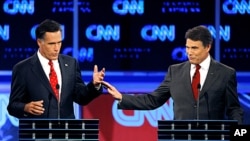



The eight U.S. Republican Party presidential hopefuls have debated social programs, immigration and the war in Afghanistan in their second debate in a week, as the 2012 election primary race takes shape.
The CNN/Tea Party debate in the southeastern state of Florida Monday night featured questions by conservative voters in the audience, over the Internet and in several U.S. states.
Front-runners Rick Perry and Mitt Romney quickly clashed over the public pension system Social Security. Former Massachusetts governor Romney pressed Texas Governor Perry repeatedly to clarify whether he still believes, as he wrote in a book, that Social Security is "unconstitutional."
Perry softened his earlier stance, saying he would not eliminate the program, but he also said he did not believe the lawmakers of the 1930s and 1940s who created it did what was "appropriate" for America.
Social Security payments represent 41 percent of the income of elderly Americans and are an important issue in Florida, which has the largest proportion of elderly voters in the United States.
On the issue of illegal immigration, Perry came under fire for his decision as Texas governor to allow children of illegal immigrants to pay the lower, in-state tuition for state universities. Romney said the policy will attract more people to enter the country illegally. U.S. Representative Michele Bachmann said it was "not the American way" to give government-sponsored subsidies to people who have broken the law.
On Afghanistan, candidates seemed to agree the U.S. should withdraw its troops as part of a transition leaving Afghan forces in charge of security, but they disagreed on the extent of future U.S. involvement in the country.
A CNN/ORC International Poll released Monday found 30 percent of Republicans and independents leaning toward the party prefer Perry, followed by 18 percent for Romney.
But the poll found that about three-fourths of those potential voters just want a candidate who can beat President Barack Obama - a Democrat - rather than one they agree with on every issue. Forty-two percent of those surveyed say they believe Perry is that candidate.
Bachmann, who had previously surged in the polls, saw her numbers drop from 10 percent to 4 percent, a major loss for the Tea Party favorite who last month won the Iowa Straw Poll, an unofficial, non-binding voting contest.
The latest poll put former Alaska governor Sarah Palin in third with 15 percent, although she has not announced her candidacy.
US Republican Hopefuls Debate in Key Election State