



U.S. researchers predict cholera will hit almost twice as many Haitians this year as the U.N. has estimated. The new analysis suggests there will be more than three quarters of a million cases of the disease.
Haiti had been free of cholera for about a century until last October, when the first cases were reported. The outbreak came nine months after the devastating earthquake, though it's not exactly clear how the two are related.
Jason Andrews of Harvard Medical School and colleagues have just published a new study projecting the course of the epidemic over the next year.
Andrews says the United Nations originally projected there would be 200,000 cases of cholera. "They then revised that estimate to project that 400,000 cases would occur over the next year. In our model, we projected 779,000 cases of cholera and 11,000 deaths."
The new study uses a more sophisticated mathematical model of the likely course of the outbreak than the U.N. used for its estimates.
Andrews' projection includes assumptions about improving water supplies, vaccination, and the use of antibiotics. He says his model indicates that those interventions can make a real difference in the ultimate impact of the epidemic.
"Certainly, if more aggressive interventions were done, such as vaccinating a larger proportion of the population or a faster rollout of clean water, the impact of interventions could be greater," he says. "But what we found was by doing all three of these interventions, you could avert a substantial burden of cholera and a substantial burden of deaths over the coming year, and that's one of the main messages of my analysis."
Public health experts continue to debate the best way to control cholera - vaccination versus antibiotics versus sanitation. But Andrews says his model shows that even modest use of all three can have a significant impact in reducing cholera illness and death.
The model in Andrews' study projects the course of the epidemic for the next year, but it doesn't indicate when Haiti will again be free of cholera.
"This is not something we looked at in the model, and it would be extraordinarily difficult to predict right now. Our prediction right now is that it will be endemic in Haiti at least over the next year and for some time to come, which means that a significant number of people will continue to be infected with cholera."
US Researchers Predict Widening Outbreak Of Cholera in Haiti
- By Art Chimes
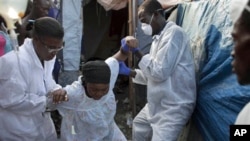
New study projects course of the epidemic over the next year