



A ballistic missile defense system stationed in Europe has been a contentious issue between the United States and Russia for many years.
The Bush administration first proposed to deploy 10 missile interceptors in Poland and a radar facility in the Czech Republic. That proposal addressed Iran’s long-range ballistic missile threat. But in September 2009, President Barack Obama canceled the Bush plan, opting for what experts describe as a more flexible approach.
Daryl Kimball, head of the Arms Control Association, a private research group, said the Obama system is designed to deal with the missile threat that already exists - the short and medium-range missiles that could come from Iran.
“They [Iranians] have short-range ballistic missiles that are capable of reaching their immediate neighbors within a couple hundred kilometers of their border," said Kimball. "They have some medium-range missiles that can strike the edges of Europe and Israel - all of these are armed with conventional warheads.”
Obama missile-defense plan
The Obama plan involves putting SM-3 ground-based interceptors in Poland by 2015 and in Romania by 2018. These are still being developed.
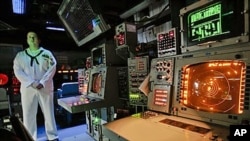
But Marko Papic, analyst with STRATFOR, a private intelligence firm, said there are SM-3 missiles aboard U.S. Navy ships and those are included in the Obama missile defense plan.
“The United States can position wherever the threat is most imminent from," said Papic. "So, for example, the U.S. could steam its vessels into the Baltic Sea or the Mediterranean or the Black Sea and position a counter to potential missile threats from the Middle East or from North Korea from there - which is why the ground-based component of it, it’s not really clear it’s even necessary.”
For years, Russian officials have criticized the U.S. missile defense plan. They do not believe its goal is to defend against possible missile attacks from rogue countries.
Russia's suspicion
Arms control expert Joseph Cirincione said Russia is convinced the U.S. seeks advantage over Moscow, knowing its nuclear forces are slowly declining.
“They are aging and Russia doesn’t have the money to replace them one-for-one," said Cirincione. "They are worried that the U.S. is going to seek some advantage by putting up a ring of anti-missile systems around Russia, supposedly aimed at Iran but the Russians believe secretly aimed at them, and then be able to take out Russia’s nuclear forces in a first strike, mopping up whatever is left by an anti-missile system that could shoot down Russian missiles. That is a complete fantasy, by the way. There is no truth to that whatsoever.”
Papic with STRATFOR said that for Moscow, it really doesn’t matter what kind of missiles the Americans put in place in Europe.
“Because ultimately, the Russian deterrent is not countered by this plan - and that’s because Russia has an overwhelming number of intercontinental ballistic missiles that it could launch on Europe if it really wanted to, with, of course, multiple warheads and things like that. So there is absolutely no way America can prevent an attack.”
Fear of US presence
Papic and others say Russia realizes the military part of its criticism is bogus. But Papic said what is unacceptable to Moscow, is that the U.S. missile defense installations represent a move by American forces into central and Eastern Europe.
“Fundamentally, what Russia doesn’t want to see, is American quote-unquote ‘boots on the ground’ - moving from their positions of Cold War Germany and Western Europe, closer to Russia’s sphere of influence and periphery,” said Papic.
At the NATO summit in Lisbon last year, the United States and Russia agreed to collaborate on the issue of missile defense. Experts say while some progress has been made, Moscow is still fundamentally opposed to the U.S. missile defense plan.