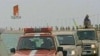



The United States, stepping up criticism of key Gulf allies, said Wednesday military means won’t resolve the political crisis in Bahrain. A senior U.S. envoy is returning to Washington after talks in Bahrain, where Saudi Arabia and the United Arab Emirates have sent police and troops.
The Obama administration is stopping short of demanding the withdrawal of the Saudi and UAE forces who entered the country Monday.
But U.S. officials say the political conflict between Bahrain’s Sunni Muslim monarchy and its majority Shi'ite populace can only be resolved by dialogue, not military force.
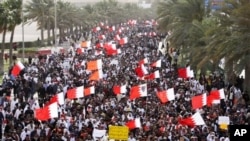
U.S. concern about the situation mounted Wednesday as Bahraini forces used helicopters and armored vehicles to drive protestors from a central plaza in the capital, Manama, that has become a focal point for demonstrations.
News reports from Manama said there were scores of injuries among protestors from bullets and buckshot, and that security forces entered ambulances and hospitals to drag away some of the injured.
The White House said President Barack Obama telephoned both Bahrain’s King Hamad al-Khalifa and Saudi King Abdullah Wednesday to urge "maximum restraint."
Ending a visit to Cairo, Secretary of State Hillary Clinton termed events in Bahrain "alarming," and said they are "diverting attention and effort away" from the political track that is the only way to resolve legitimate differences among Bahrainis.
State Department acting spokesman Mark Toner said the United States has conveyed that message to all members of the Gulf Cooperation Council, under whose banner the intervention has occurred.
"We stress here obviously that there’s no way to resolve this situation through security or excessive force," he said. "There needs to be a political dialogue that leads to a political resolution. We’re deeply troubled by reports of injuries and deaths of civilians, as well as attacks on ambulances and hospitals. We certainly object to the use of excessive force and violence against demonstrators, and we remind Bahraini officials of their obligation to protect medical facilities and to facilitate treatment of the wounded."
Bahrain is host to the U.S. Navy’s Fifth Fleet and has received extensive U.S. military aid over the years.
The State Department said last week it is investigating whether Bahrain’s use of force in previous protests violates the 1997 Leahy amendment from Congress, which bars U.S. military aid to foreign military units involved in human rights violations.
Spokesman Toner said Assistant Secretary of State for Near Eastern Affairs Jeffrey Feltman left Manama Wednesday after two days of meetings with Bahraini leaders.
The crisis has strained U.S. relations with its Gulf allies. Saudi Arabia is understood to have barred a visit by Secretary Clinton this week angry over what is seen there as U.S. encouragement to Bahraini protestors.
Saudi Arabia is concerned that the Bahrain unrest might lead to the toppling of the monarchy and a takeover by pro-Iranian elements among the opposition.
White House spokesman Jay Carney said that in his calls to the Gulf leaders Wednesday President Obama said legitimate grievances of Bahrainis can only be addressed by a political process.
He said Mr. Obama reiterated support for a national dialogue initiative led by Bahraini Crown Prince Salman.
US Says Force Won’t Solve 'Alarming' Bahrain Crisis