


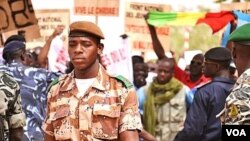
STATE DEPARTMENT - The Obama administration says leaders of military coups in Mali and Guinea Bissau must agree to West African demands to return their countries to democratic rule.
U.S. Assistant Secretary of State for African Affairs Johnnie Carson says the March military coup in Mali is a glaring exception to democratic progress in Africa.
"Twenty-one years of democratic governance was swept aside by a few mutinous soldiers who seem more concerned about their own welfare than that of the people or the nation they were supposed to be serving," said Carson. "Their action has imperiled Mali's territorial integrity, allowed rebels to take over half of the country, set back the country's economic development, and reduced the government's capacity to respond to drought conditions in the north."
Tuareg separatists in northern Mali expanded territory under their control following the collapse of the government in Bamako. Coup leader Captain Amadou Sanogo last month agreed to a regional plan for a transitional government. But he continues to hold considerable power and rejects calls for elections within 12 months.
Carson says a strong regional response by the Economic Community of West African States makes clear that what he calls "this military misadventure" has no future, and the United States fully supports ECOWAS mediation to help Mali return to democratic rule.
"A short-term transitional government that leads directly to free and fair presidential elections so that Mali can move forward with re-establishing its tradition of democratic governance is required," he said. "The military must step aside completely. Those who have illegally seized power in Mali have no right to remain in power and no strength to address the serious security and humanitarian issues that Mali faces today."
In a conference call with African reporters, Carson also said he is deeply concerned about Guinea Bissau, not only because of last month's coup but also by the country's military leaders' continued exercise of authority behind the scenes.
"With ECOWAS in the lead, the states in the region should work with the community of Portuguese-language countries and other international partners to restore democracy to that country. In democracies, the military has no role to play in governance," said Carson.
Regional power Nigeria says it is ready to send troops to both Guinea-Bissau and Mali. Following a meeting of defense chiefs from Nigeria, Ivory Coast, Sierra Leone, Togo, Burkina Faso, Cape Verde, Liberia and Gambia, ECOWAS civilian officials must now authorize those deployments.
U.S. Assistant Secretary of State for African Affairs Johnnie Carson says the March military coup in Mali is a glaring exception to democratic progress in Africa.
"Twenty-one years of democratic governance was swept aside by a few mutinous soldiers who seem more concerned about their own welfare than that of the people or the nation they were supposed to be serving," said Carson. "Their action has imperiled Mali's territorial integrity, allowed rebels to take over half of the country, set back the country's economic development, and reduced the government's capacity to respond to drought conditions in the north."
Tuareg separatists in northern Mali expanded territory under their control following the collapse of the government in Bamako. Coup leader Captain Amadou Sanogo last month agreed to a regional plan for a transitional government. But he continues to hold considerable power and rejects calls for elections within 12 months.
Carson says a strong regional response by the Economic Community of West African States makes clear that what he calls "this military misadventure" has no future, and the United States fully supports ECOWAS mediation to help Mali return to democratic rule.
"A short-term transitional government that leads directly to free and fair presidential elections so that Mali can move forward with re-establishing its tradition of democratic governance is required," he said. "The military must step aside completely. Those who have illegally seized power in Mali have no right to remain in power and no strength to address the serious security and humanitarian issues that Mali faces today."
In a conference call with African reporters, Carson also said he is deeply concerned about Guinea Bissau, not only because of last month's coup but also by the country's military leaders' continued exercise of authority behind the scenes.
"With ECOWAS in the lead, the states in the region should work with the community of Portuguese-language countries and other international partners to restore democracy to that country. In democracies, the military has no role to play in governance," said Carson.
Regional power Nigeria says it is ready to send troops to both Guinea-Bissau and Mali. Following a meeting of defense chiefs from Nigeria, Ivory Coast, Sierra Leone, Togo, Burkina Faso, Cape Verde, Liberia and Gambia, ECOWAS civilian officials must now authorize those deployments.