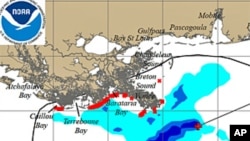



U.S. scientists said Wednesday that the oil spill from a massive leak underwater leak in the Gulf of Mexico has entered a current that flows past Florida and several other U.S. states. Marine experts are concerned the current could enable the oil leak to have a broader impact.
U.S. Government scientists confirmed that a light oil sheen has entered the Loop Current that flows north from the Caribbean Sea and east around the Florida peninsula.
The National Oceanic and Atmospheric Administration, or NOAA, said planes first spotted the sheen on Tuesday. Scientists say is it uncertain that oil in the Loop Current will reach Florida, adding it would take more than a week to do so.
But NOAA science coordinator Charlie Henry says the danger to the state's environment will be diminished.
"That oil is going to move slowly with the Loop Current," said Charlie Henry. "And we expect most of that to dissipate or degrade before it would come close to threatening the south Florida area."
So far, scientists have found no traces of the oil spill in Florida. They say tests confirmed that tar balls found on south Florida beaches on Tuesday were not from the BP leak.
University researchers and independent groups also have been tracking the sheen, amid concerns that the Loop Current could transport oil for hundreds of kilometers. The oil could ruin beaches and marine habitats in several U.S. states and Caribbean nations.
In Havana, U.S. and Cuban officials met to discuss how to respond to the leak that is releasing an estimated 5,000 barrels of oil a day. The Loop Current flows between Florida and Cuba.
After several failed efforts, the BP oil company is deploying more equipment to the site of the disaster to plug the leak. The latest attempt involves placing a tube into the well, and pumping in mud and cement to stop the flow of oil.
U.S. Coast Guard Rear Admiral Mary Landry, who is overseeing the response, says everyone is optimistic that the technique known as "top kill" will be successful.
"We absolutely are holding out hope that top kill works," said Admiral Landry. "Everybody is very anxious to see success with this intervention."
BP says it has some 20,000 people working to stop the leak and clean up the oil that has flowed into the Gulf of Mexico. Teams continue to spray chemical dispersants and burn oil on the water's surface to minimize the impact of the spill.
US Scientists: Massive Oil Spill Enters Gulf of Mexico Current