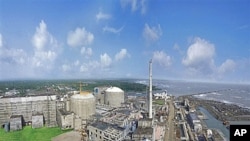
The United States is seeking ways to change a new law covering the nuclear power industry in India so that U.S. nuclear suppliers would not be liable in the event of an accident in that country.
The Indian parliament overwhelmingly approved legislation in August that will open the country's $150-billion nuclear power market to foreign investors. The legislation, however, extends liability to suppliers of nuclear reactors - not just to power plant operators - as is common in most countries.
The U.S. State Department said this week it is looking "to the Indian government to see what changes can be made" to the law. Prime Minister Manmohan Singh, though, said the law passed with near unanimity and cannot now be changed.
The passage of the law is an outgrowth of the 2005 U.S.-Indian civil nuclear agreement that ended an international moratorium on nuclear trade with India that had been in place since India's first atomic-weapons tests in 1974.
India sought to pass the law in advance of U.S. President Barack Obama's planned visit to India in November.
Opening the Indian nuclear market could provide new business for such U.S. firms as General Electric Co. and Westinghouse Electric Co.
But if the liability issue is not resolved, the Wall Street Journal says the U.S. firms would be at a disadvantage to state-controlled Russian and French nuclear-equipment companies because their governments provide them with some liability protection.
The newspaper says the issue could be sidestepped several ways: by a separate U.S. government agreement with the Indian government, by India ignoring the liability provision in the law, or by a separate signing agreement between India's only nuclear operator and any U.S. suppliers.
India's main opposition political party, the Bharatiya Janata Party, however, said there should not be any dilution of the law. A party spokesman said "the rules should be loaded in favor of the victim and not the supplier."
US Seeks Changes in India's New Nuclear Law