


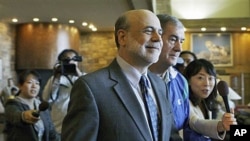
Despite very high expectations, the head of the U.S. central bank on Friday did not announce any major steps to bolster the U.S. economy. Speculation had been running high that Federal Reserve Chairman Ben Bernanke would use his scheduled speech at a gathering of top economist in the western state of Wyoming to announce a third round of quantitative easing. Instead, Bernanke leaned on Congress to do more to restore the nation's economic health.
Former central bank official Vincent Reinhart, now an analyst at the American Enterprise Institute was not surprised by the reaction on Wall Street.
"Wall Street almost always gets ahead of itself," said Reinhart. "If you want to know the most selfish person on earth, it's an investor - because every conversation has to end with 'What does it mean for me?' And what the speech today meant for them is - not a lot."
Expectations were high because it was at the same gathering last year that Bernanke announced a second round of quantitative easing - essentially the purchase of $600 billion worth of U.S. debt to lower interest rates and boost business and consumer spending.
European markets had equally high expectations, especially with new figures showing the U.S. economy grew at a slower pace than initial estimates in the first half of this year.
German market analyst Robert Halver said the U.S. needs a large-scale program similar to one initiated in 1948 that helped to rebuild Europe's war-ravaged economies.
"America needs a demand solution for its problems, not even more liquidity. We have a big chance of risk of recession in America and that's why America needs a new Marshall Plan, a new deal," said Halver.
Vincent Reinhart at AEI said it may not happen immediately, but he believes significant Fed action is just around the corner.
"I think ultimately the Federal Reserve will go to QE3 [Quantitative Easing 3]. They'll go to QE3 because there is a persistent drag on the economy and the unemployment rate will stay high," said Reinhart.
Of course, much will depend on the Fed's assessment of the U.S. economy at its next meeting in September. But Bernanke insists he still has a range of tools at his disposal. He also urged Congress and the White House to do more to jump start the economy.
Given the political climate in Washington, New York financial expert Jon Henes is not holding his breath.
"I'm not optimistic that will happen, not going into an election year," said Henes.
Despite increased pessimism and growing fears of a double-dip recession, key indexes on Wall Street closed higher Friday - on Fed sentiments that the long-term prospects for the U.S. economy remain strong.