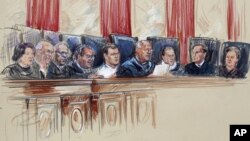
WASHINGTON - Monday’s decision by the Supreme Court of the United States striking down most of Arizona’s controversial immigration law virtually ensures that immigration will be a major issue in this year's presidential campaign.
Most of the Arizona law targeting illegal immigrants was struck down, including a provision that allowed police to arrest suspected illegal aliens in the state without warrants.
But the Supreme Court allowed the most controversial aspect of the law to stand. That provision requires local police to check the immigration status of people stopped for other reasons, if they have a reasonable suspicion the person is in the United States illegally. Critics say this part of the law can lead to racial profiling.
Many immigration activists see the high court’s ruling as a victory with a likely impact on November's presidential election.
“The Supreme Court had their say today. On November the 6th, Latinos will have the final word," said Eliseo Medina, who is with the Service Employees International Union in Washington D.C. "We will in fact say this law is wrong. It will be overturned by the power of our votes.”
In the wake of the ruling, President Barack Obama issued a statement calling on Congress to pass comprehensive immigration reform. His expected Republican opponent in November, former Massachusetts Governor Mitt Romney, issued a statement accusing the president of failing to lead on immigration.
Both sides of the debate took something from the high court's ruling, and analysts say that could energize activists across the political spectrum ahead of the election.
But University of Virginia political scientist Larry Sabato says critics of the Arizona law have more to celebrate than supporters.
“You’ve got both sides celebrating something," he said. "But as you look at the decision, the Supreme Court has upheld the federal government’s position to a much greater degree than Arizona’s position.”
Quinnipiac University pollster Peter Brown says the high court's decision will have short- and long-term implications.
“What the Supreme Court ruling on immigration does is keep the issue front and center in the political debate," he said. "And in the long-term, it means that it is likely that a large number or many state legislatures will take up similar statutes, at least the parts that have been approved by the Supreme Court.”
Five others states have enacted laws similar to the Arizona statute and were awaiting the Supreme Court's ruling.
The Arizona law came before the high court after a lower court challenge by the Obama administration. Analyst Sabato says that should help the president with Hispanic voters in November.
“This was a case that Hispanics and Latinos were paying particularly close attention to, and this is literally the one segment of the electorate where President Obama is doing as well or better than he did four years ago," he said. "So it’s the kind of decision that has implications for the fall vote.”
Given the nation's weak economy, analyst Charlie Cook says the president will need to match his strong support among Hispanic voters this year, if he is to win a second term.
“The president got 67 percent of Latinos in the last election," he said. "And in some Gallup polling I’ve seen recently he has that same 67 percent, if they vote. But there are some very strong warning signals in the polling that while if they show up and vote they are very heavily likely to vote for President Obama, there is a lack of enthusiasm about this election and they may not show up.”
Experts say the president might have also helped his chances with Hispanic voters recently when he ordered an end to the deportations of hundreds of thousands of young illegal immigrants who were brought into the country by their parents.
Most of the Arizona law targeting illegal immigrants was struck down, including a provision that allowed police to arrest suspected illegal aliens in the state without warrants.
But the Supreme Court allowed the most controversial aspect of the law to stand. That provision requires local police to check the immigration status of people stopped for other reasons, if they have a reasonable suspicion the person is in the United States illegally. Critics say this part of the law can lead to racial profiling.
Many immigration activists see the high court’s ruling as a victory with a likely impact on November's presidential election.
“The Supreme Court had their say today. On November the 6th, Latinos will have the final word," said Eliseo Medina, who is with the Service Employees International Union in Washington D.C. "We will in fact say this law is wrong. It will be overturned by the power of our votes.”
In the wake of the ruling, President Barack Obama issued a statement calling on Congress to pass comprehensive immigration reform. His expected Republican opponent in November, former Massachusetts Governor Mitt Romney, issued a statement accusing the president of failing to lead on immigration.
Both sides of the debate took something from the high court's ruling, and analysts say that could energize activists across the political spectrum ahead of the election.
But University of Virginia political scientist Larry Sabato says critics of the Arizona law have more to celebrate than supporters.
“You’ve got both sides celebrating something," he said. "But as you look at the decision, the Supreme Court has upheld the federal government’s position to a much greater degree than Arizona’s position.”
Quinnipiac University pollster Peter Brown says the high court's decision will have short- and long-term implications.
“What the Supreme Court ruling on immigration does is keep the issue front and center in the political debate," he said. "And in the long-term, it means that it is likely that a large number or many state legislatures will take up similar statutes, at least the parts that have been approved by the Supreme Court.”
Five others states have enacted laws similar to the Arizona statute and were awaiting the Supreme Court's ruling.
The Arizona law came before the high court after a lower court challenge by the Obama administration. Analyst Sabato says that should help the president with Hispanic voters in November.
“This was a case that Hispanics and Latinos were paying particularly close attention to, and this is literally the one segment of the electorate where President Obama is doing as well or better than he did four years ago," he said. "So it’s the kind of decision that has implications for the fall vote.”
Given the nation's weak economy, analyst Charlie Cook says the president will need to match his strong support among Hispanic voters this year, if he is to win a second term.
“The president got 67 percent of Latinos in the last election," he said. "And in some Gallup polling I’ve seen recently he has that same 67 percent, if they vote. But there are some very strong warning signals in the polling that while if they show up and vote they are very heavily likely to vote for President Obama, there is a lack of enthusiasm about this election and they may not show up.”
Experts say the president might have also helped his chances with Hispanic voters recently when he ordered an end to the deportations of hundreds of thousands of young illegal immigrants who were brought into the country by their parents.