



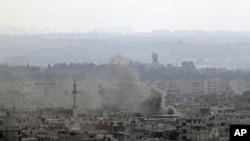
The Obama administration said Monday that it is pressing countries to cut financial ties with Syria in the face if what the State Department calls an “abhorrent and repulsive” crackdown on dissent. The monitoring group Human Rights Watch said it is time for the Arab League to push for an end to the violence.
Officials here say there is little more the United States can do in terms of economic pressure on Syria, and that U.S. diplomacy is focused on pressing countries that still trade with or sell arms to the Damascus government to end those relationships.
The comments came as the focus of the Syrian crackdown moved to the coastal city of Latakia, where residents and human rights groups say government forces shelled southern neighborhoods and a Palestinian refugee camp, forcing thousands of people to flee.
State Department Spokesperson Victoria Nuland said there were “inconsistencies” in reports that Syrian naval vessels had shelled parts of Latakia. But she said armored vehicles were in the city “firing on innocents” and that it is clear that Syrian President Bashar al-Assad is not responsive to growing calls to end to the violence.
“This is a guy who is not hearing, as the secretary [of state] called it, the increasing chorus of condemnation from the international community, which is why we are working hard now with our partners around the world to increase the pressure - political and economic. But we share the concern around the world that this is a man who is slaughtering innocents, again and again and again,” Nuland said.
Nuland said that despite five months of violence against demonstrators, there still are countries buying Syrian oil and gas and that have not renounced arms sales to Syria. She said the United States is working to strengthen curbs on the Damascus government to insure that “the message from the international community has teeth.”
Arab governments have been reluctant to criticize Damascus. But Jordan's Prime Minister Marouf al-Bakhit on Monday called for a quick end to Syrian military operations and urgent, concrete action on political reforms.
In a letter to Arab League Secretary-General Nabil al-Arabi, Human Rights Watch urged the pan-Arab organization to hold an emergency meeting on Syria and press the Damascus government to admit a U.N.-mandated fact-finding committee, journalists and independent observers.
The New York-based monitoring group said that to remain relevant, the Arab League needs to break from its history as a grouping of “autocrats who support each others crimes,” and support the interests of member countries’ citizens.
Human Rights Watch Global Advocacy Director Peggy Hicks said the collective voice of the Arab League and its members would be “particularly powerful” in telling President Assad to end the crackdown and rethink his policies, especially those excluding outside monitors.
“It is very concerning that even in the face of a [U.N.] Security Council presidential statement, they’ve continued to escalate the abuse rather than scale it back. What we really need is to have monitors on the ground who would be able to assess this. The Syrians, of course, keep claiming that some of this is provoked by armed gangs or protestors. But the fact is that Syria itself has unilaterally blocked all access of anybody who would be able to verify those claims independently,” Hicks said.
Human Rights Watch said that although the Arab League has remained generally silent on Syria, its charter endorses international covenants and affirms the rights to freedom of assembly and expression as well as protection from torture.
The group said the “sustained campaign of repression” in Syria has left an estimated 2,000 people dead, including more than 120 people killed since the beginning of Ramadan a week ago.