


Thanksgiving is the quintessential American holiday and roast turkey is the definitive centerpiece of the holiday feast.
But the domesticated turkey is not an American invention.
It's Mexican.
The bird was first domesticated in Mesoamerica, what is now Mexico, at around 800 B.C., says Julie Long, a turkey researcher with the U.S. Department of Agriculture.
"The Mesoamericans had turkey meat all the time," she says.
Enter the Spanish
When the Spanish conquistadors arrived in the 1500s, "They discovered these domesticated turkeys, which were a lot better than the birds they were eating in Europe," Long says.
The Spanish were used to eating birds like peacocks, pretty to look at, but not much meat on them.
"Those are just sort of scrawny little birds," she says. "And, of course, chickens at that time were scrawny little birds."
Compared to a nice, meaty turkey, it was no contest.
Turkey conquers Europe
Along with corn, peppers and tomatoes, the Spanish took turkeys back to Europe with them.
Over the next 100 years, turkeys spread from Spain to Holland and all the way up to England, where goose was the traditional English Christmas feast until turkey came to town.
"To the English at the time, they thought they tasted better than a goose," Long says. "So at Christmas you would actually be doing very well if you got a turkey as opposed to a goose."
Back to the Americas
From 17th-century England, turkeys made their way back to the Americas. English settlers brought the birds and other livestock with them to the Massachusetts Bay Colony in the 1630s.
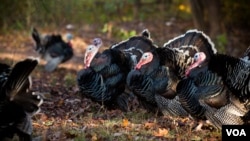
A decade or so earlier, when the Pilgrims landed in nearby Plymouth, they found the woods were already full of wild turkeys, distant cousins of the birds domesticated in Mesoamerica.
Pilgrim writings "refer to turkeys as being ‘fat and sweet,’" says Kathleen Wall, a colonial food expert at the Plimoth Plantation museum in Plymouth, Massachusetts. She says the birds also made for easy hunting.
"You can go out at twilight and the turkeys roost in trees and you can shoot them off their roost. They sit still while you shoot at them," Wall says.
Wild turkeys decline
Fat, sweet and easy to shoot, it didn't take long before colonists like Gov. William Bradford started writing about the wild turkey's decline.
"One of the things he mentions in the 1640s is how things that were so abundant in 1620 and in 1630 are suddenly disappearing," Wall says.
By the late 1640s, it was a good idea to raise domesticated turkeys because the wild birds were getting harder to find.
Their populations continued to decline as America moved west, hitting a low point in the 1930s.
Recovery
Conservation efforts in the late 20th century started bringing the wild turkey back. Wall says there are enough of them today that occasional attacks on suburbanites are reported.
One turkey that repeatedly attacked a Massachusetts postman had to be forcibly relocated.
As for the original Mexican wild turkey - the great-great grandfather of today's Thanksgiving bird - the U.S. Department of Agriculture's Long says it's probably extinct.
"There are some turkeys that are down there that exist on preserves," she says. "But nobody knows for sure whether those are the original wild birds."
But its descendents live on at the heart of the American Thanksgiving celebration.