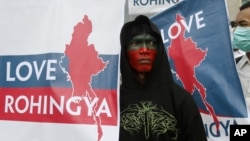
The United States is urging Bangladesh to allow international humanitarian groups to continue providing aid to ethnic Rohingya refugees who have fled deadly sectarian violence in neighboring Burma.
Last week, Bangladesh ordered three NGOs to stop their activities in the southeastern district of Cox's Bazar. Officials said the move was meant to discourage more people from crossing the border from Burma.
The U.S. State Department said late Tuesday it is "deeply concerned" about Bangladesh's intent to shut down the groups, which include Doctors Without Borders, Action Against Hunger and Muslim Aid.
Sectarian violence between Buddhists and Rohingya Muslims in Burma's western Rakhine state has left dozens dead since June. Many Rohingya, who are considered illegal immigrants in Burma, have attempted to flee into Bangladesh.
But the Rohingya are also denied citizenship in Bangladesh, which argues the group has been living in Burma for centuries. Bangladesh has also angered rights groups by turning away boats carrying scores of Rohingya.
The State Department says it continues to monitor the ethnic and sectarian tensions in Burma and that it wants the government to reach a peaceful solution to the conflict as soon as possible.
The violence began in late May when long-simmering tensions between Buddhists and Rohingya erupted into communal violence after three Muslim men were accused of raping and murdering a young Buddhist woman.
Rights groups such as Human Rights Watch and Amnesty International say Burmese security forces carried out a campaign of violence and mass arrests against the Rohingya in the aftermath of the unrest.
Burma's government, which has a long history of violence against ethnic minorities, has denied the accusations, saying its security forces acted with restraint in dealing with the Rohingya.
The conflict threatens to put a damper on the recent political and economic reforms carried out by Burma's nominally civilian government. Matthew Smith, a researcher with Human Rights Watch, said in the Wall Street Journal Wednesday that Burma's government is willfully ignoring a "human rights disaster" and warned world leaders against undue optimism regarding Burma.
Foreign governments, including a recent wave of Muslim-majority countries, have been putting increasing pressure on President Thein Sein to bring an end to what some consider to be state-sanctioned discrimination against Burma's estimated 800,000 Rohingya.