


Egypt’s military is playing a pivotal and perhaps evolving role in the demonstrations in Egypt, and U.S. defense leaders are staying in close touch with their counterparts in Cairo. So far officials and analysts say the army is acting properly, but they also note that the situation is changing constantly.
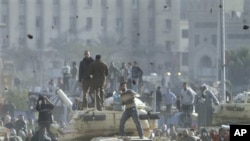
As crowds of anti-government protesters clashed with government supporters Wednesday, the Egyptian Army units in the streets mostly stood on the sidelines. To some observers, including Dr. Tawfik Hamid, that seemed to change on Thursday.
“Certainly, they are changing," said Hamid. "It’s not 180 degrees but I can see there is the beginning of a change. They started today to protect the demonstrators from the Mubarak supporters.”
That change, noted by the senior fellow at the Potomac Institute, coincided with official Egyptian condemnation of the violence instigated by pro-government demonstrators - violence widely believed to have been orchestrated by senior officials. On Monday, Dr. Hamid predicted the Army would side with the protesters and force President Hosni Mubarak to resign. That had not happened by Thursday, and Hamid believes the Army leadership is running out of time.
“The more the military is showing delay in taking a clear stand with the people against Mubarak, the more the people will feel they [the soldiers] are part of Mubarak and they will never trust them in the future," he said.
The Egyptian Army leaders are in a delicate position, after decades of following President Mubarak, himself a former military man. So far, Pentagon spokesman Colonel David Lapan says the troops are doing a good job.
“To date, we have seen them act professionally and with restraint," said Colonel Lapan. "It’s a very fluid situation so we’re watching every single day.”
Retired U.S. Army Major General Paul Eaton agrees.
“What I have seen is an army that is behaving rationally," said Eaton. "I don’t know what their standing orders are, but their conduct seems to be stable, friendly, engaged with the people.”
General Eaton, now a senior advisor to the National Security Network research organization, visited Cairo in 2003 for talks with senior Egyptian military leaders. He says he was impressed with the level of comfort he found in the U.S.-Egyptian military relationship.
“It was beyond cordial," he said. "There was a warmth associated with it that I would expect has been brought to play here. We’ve got a strong relationship. And that has proven very helpful in the past with other armies. I would expect that it will prove so [in] this case.”
Indeed, the top U.S. military officer, Admiral Mike Mullen, has spoken at least twice with his Egyptian counterpart in the last few days, and U.S. Defense Secretary Robert Gates has had at least three conversations with Egypt’s defense minister.
The close relationship comes from decades of exchanges, meetings, training courses and military equipment sales following the signing of the Egypt-Israel peace treaty in 1979. The White House press secretary says some of that could be in jeopardy, depending on how the Egyptian government handles the current crisis.
The Pentagon spokesman, Colonel Lapan, says much of the training these days involves high technology air, sea and counter-terrorism gear. But he says it also includes officer training at the same U.S. military schools American officers attend.
“It’s leadership," he said. 'It’s military skills. But it’s really about being a professional military force. So it’s inculcating in their officers the same thing that happens for officers in our military force.”
That includes values such as respect for civilian authority and for the rights of the people - concepts that could come into conflict in Egypt if the government orders a crackdown on the demonstrators. When the United States has cut off such training for other countries, such as Indonesia, because of Human Rights violations, analysts say the loss of contact has made those militaries more likely to violate their people’s rights, and made it more difficult for the United States to exert influence.
At least so far, the opposite is true in Egypt, where American officers have extensive contacts and at least the ability to be heard by key military players. The retired general, Paul Eaton, attended an advanced officer training course with an Egyptian general, and saw other Egyptian officers in action when he supervised training programs. He calls them “sober” and “professional,” and says the junior officers are in touch with the conscript soldiers who serve under them.
“What I am hoping is that the army retains a role that will not challenge their credibility in the eyes of the Egyptian people and that they will serve as the primary broker for whatever change we now see in the Egyptian leadership," he said.
U.S. officials are using their contacts to do what they can to encourage a governmental transition and to promote restraint by the Egyptian Army. The next big test will come Friday - traditionally a day for protests after the main mid-day Muslim prayers of the week.
US Watches Egypt’s Army as Protests Continue
- By Al Pessin