


STATE DEPARTMENT -- The United States is adding Syria to a list of countries that could face sanctions for not doing enough to fight human trafficking. The annual U.S. report on worldwide slavery says Burma and Venezuela are among those countries making progress.
The State Department report says thousands of women from Somalia, Indonesia, Iraq and the Philippines are victims of prostitution and forced labor in Syria after being duped by fraudulent employment agencies. The report puts President Bashar al-Assad's government on a list of countries that could face sanctions over these abuses because it says Damascus is failing to investigate or punish those responsible.
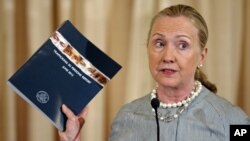
Releasing the study of conditions in more than 180 nations, Secretary of State Hillary Clinton said Tuesday that some people are lured abroad by false promises of new opportunities and that others are abused in their own countries.
"These victims of modern slavery are women and men, girls and boys," she said. "And their stories remind of us what kind of inhumane treatment we are still capable of as human beings."
Along with Syria, the 2012 report says human trafficking is worst in Algeria, the Central African Republic, Saudi Arabia, Congo, Cuba, Sudan, Equatorial Guinea, Yemen, Eritrea, Iran, North Korea, Zimbabwe, Kuwait, Libya, Madagascar and Papua New Guinea.
"Traffickers prey on the hopes and dreams of those seeking a better life," Clinton said. "And our goal should be to put those hopes and dreams within reach, whether it is getting a good job to send money home to support a family, trying to get an education for oneself or one's children, or simply pursuing new opportunities that might lead to a better life. We need to ensure that all survivors have that opportunity to move past what they endured and to make the most of their potential."
The report focuses on the need for prevention, protection, and prosecution. Secretary Clinton highlighted the accomplishments of individuals who are fighting human trafficking in Mauritania, Aruba, the Sinai Peninsula, Argentina, Cambodia and Congo.
"They do remind us that one person's commitment and passion, one person's experience and the courage to share that experience with the world, can have a huge impact," she said.
Congolese physician Raimi Vincent Paraiso spoke on behalf of those recognized for their work against human trafficking.
Dr. Paraiso said human trafficking has reached alarming proportions around the world. He noted that the Republic of Congo and many other countries represented here unfortunately are not spared from this crime, and that the international community can not remain silent and must continue to respond relentlessly.
The International Labor Organization says at least 21 million people are enslaved around the world.
The State Department report says the number of trafficking victims identified by governments worldwide is up 28 percent - from more than 33,000 last year to more than 42,000 this year, but with notable improvements in Venezuela and Burma.
The report commends Venezuela for strengthening anti-trafficking laws, improving training for border patrols and law enforcement, and launching public information campaigns against slavery. But it says President Hugo Chavez's government falls short of minimum standards to eliminate human trafficking because of weak prosecution efforts and insufficient victim services.
The report says Burma is taking "unprecedented steps" to fight human trafficking by repealing laws used to justify forced labor, while better identifying and helping victims of slavery. It says trafficking by private individuals and government officials continues to be a "significant problem" along with the conscription of child soldiers in areas of ethnic conflict.
The State Department report says thousands of women from Somalia, Indonesia, Iraq and the Philippines are victims of prostitution and forced labor in Syria after being duped by fraudulent employment agencies. The report puts President Bashar al-Assad's government on a list of countries that could face sanctions over these abuses because it says Damascus is failing to investigate or punish those responsible.
Releasing the study of conditions in more than 180 nations, Secretary of State Hillary Clinton said Tuesday that some people are lured abroad by false promises of new opportunities and that others are abused in their own countries.
"These victims of modern slavery are women and men, girls and boys," she said. "And their stories remind of us what kind of inhumane treatment we are still capable of as human beings."
Along with Syria, the 2012 report says human trafficking is worst in Algeria, the Central African Republic, Saudi Arabia, Congo, Cuba, Sudan, Equatorial Guinea, Yemen, Eritrea, Iran, North Korea, Zimbabwe, Kuwait, Libya, Madagascar and Papua New Guinea.
"Traffickers prey on the hopes and dreams of those seeking a better life," Clinton said. "And our goal should be to put those hopes and dreams within reach, whether it is getting a good job to send money home to support a family, trying to get an education for oneself or one's children, or simply pursuing new opportunities that might lead to a better life. We need to ensure that all survivors have that opportunity to move past what they endured and to make the most of their potential."
The report focuses on the need for prevention, protection, and prosecution. Secretary Clinton highlighted the accomplishments of individuals who are fighting human trafficking in Mauritania, Aruba, the Sinai Peninsula, Argentina, Cambodia and Congo.
"They do remind us that one person's commitment and passion, one person's experience and the courage to share that experience with the world, can have a huge impact," she said.
Congolese physician Raimi Vincent Paraiso spoke on behalf of those recognized for their work against human trafficking.
Dr. Paraiso said human trafficking has reached alarming proportions around the world. He noted that the Republic of Congo and many other countries represented here unfortunately are not spared from this crime, and that the international community can not remain silent and must continue to respond relentlessly.
The International Labor Organization says at least 21 million people are enslaved around the world.
The State Department report says the number of trafficking victims identified by governments worldwide is up 28 percent - from more than 33,000 last year to more than 42,000 this year, but with notable improvements in Venezuela and Burma.
The report commends Venezuela for strengthening anti-trafficking laws, improving training for border patrols and law enforcement, and launching public information campaigns against slavery. But it says President Hugo Chavez's government falls short of minimum standards to eliminate human trafficking because of weak prosecution efforts and insufficient victim services.
The report says Burma is taking "unprecedented steps" to fight human trafficking by repealing laws used to justify forced labor, while better identifying and helping victims of slavery. It says trafficking by private individuals and government officials continues to be a "significant problem" along with the conscription of child soldiers in areas of ethnic conflict.