USS George Washington Leads Joint Maneuvers With S. Korea
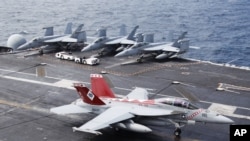
A U.S. Navy F/A-18 Super Hornet lands the deck of U.S. aircraft carrier USS George Washington during joint military drills between the U.S. and South Korea in the Yellow Sea, southwest of Seoul, June 24, 2012.
USS GEORGE WASHINGTON, Yellow Sea - In a show of force that South Korea's military says is meant as a warning to North Korea, a U.S. naval carrier strike group is conducting maritime maneuvers with South Korea off the coast of the tense peninsula.
The USS George Washington is leading its carrier strike group, part of a flotilla of 10 warships and submarines, off the west coast of the Korean peninsula. Also participating in this three-day exercise, which ends Monday, are hundreds of combat aircraft. In all, 8,000 military personnel of the United States and South Korea are involved.
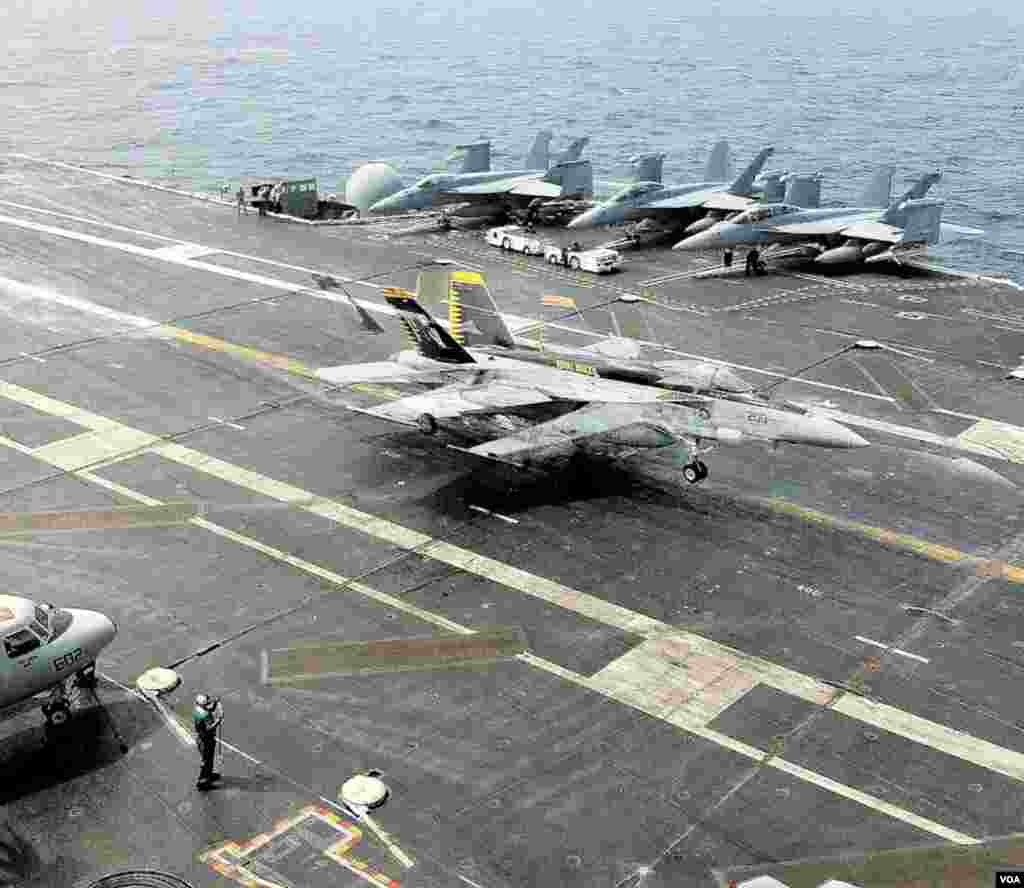
The tailhook of an incoming U.S. Navy F-18 fighter jet is grabbed by an arresting wire on the flight deck of the George Washington in international waters, about 200 kilometers south of the disputed maritime border between the two Koreas.
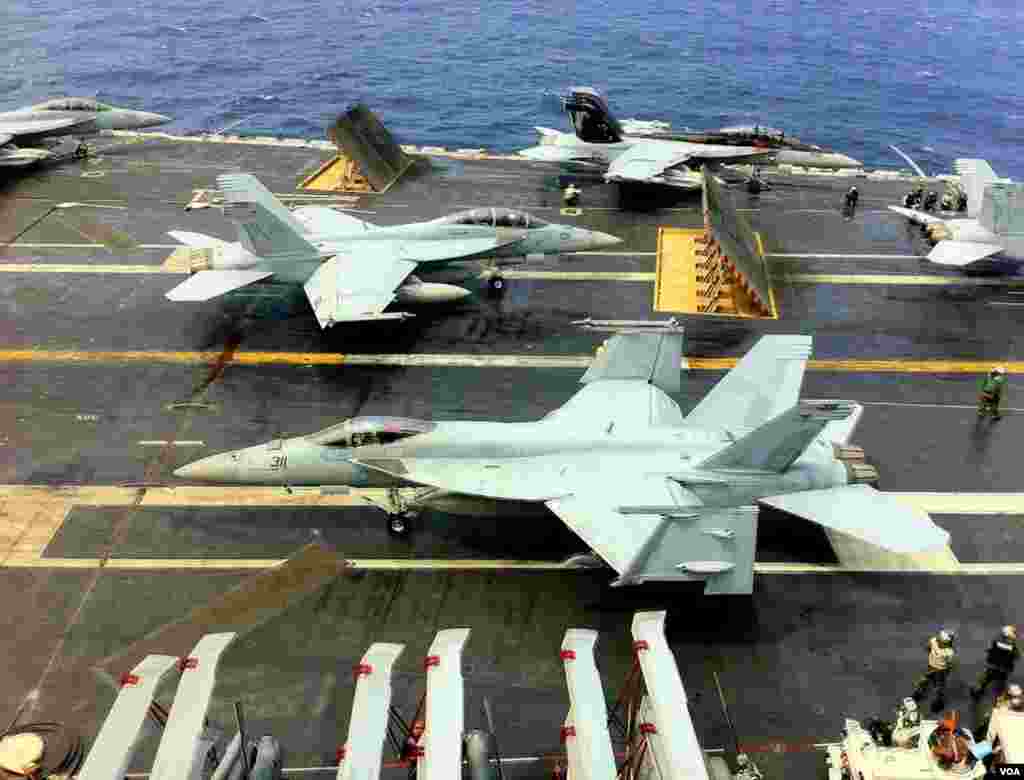
For hours at a time planes are landing and being catapulted off the 330-meter-long carrier.
A F-18 fighter jet landing on the USS George Washington in the Yellow Sea:
South Korea's military is characterizing this and other current exercises as containing a potent message to North Korea. To paraphrase that message: Pyongyang, this is what you will face if you dare to carry out another act of aggression.
Both North Korean and Chinese officials have expressed concern about a U.S. aircraft carrier returning to these waters, warning that the joint naval exercise threatens the region's peace and stability.
But the commanding officer of the USS George Washington, Captain David Lausman, says the presence of his carrier's strike group here is a routine opportunity to improve coordination with South Korea's navy.
“The only point of this exercise right now for the U.S. and Republic of Korea: we are working together," he said. "The invitation is to do this with every country that we meet in international waters.”
And, Lausman says, that invitation includes China.
With such a show of force underway by the U.S. and South Korean navies - including destroyers, frigates, fighter jets, early warning aircraft and submarines - Pyongyang and China have limited their responses to rhetoric.
US, South Korean Navies Conduct Major Exercise
1/6An F-18 fighter jet's tailhook is grabbed by an arresting wire on the flight deck of the USS George Washington in the Yellow Sea, June 24, 2012. (VOA/S. Herman)
In a show of force that South Korea's military says is meant as a warning to North Korea, a U.S. naval carrier strike group is conducting maritime maneuvers with South Korea off the coast of the tense peninsula. The USS George Washington is leading its carrier strike group, part of a flotilla of 10 warships and submarines.
Show moreShow less
2/6A close-up look at the nose of an F-18 fighter jet in the expansive hangar bay of the USS George Washington, June 24, 2012. (VOA/S. Herman)
In a show of force that South Korea's military says is meant as a warning to North Korea, a U.S. naval carrier strike group is conducting maritime maneuvers with South Korea off the coast of the tense peninsula. The USS George Washington is leading its carrier strike group, part of a flotilla of 10 warships and submarines.
Show moreShow less
3/6Veterano de la infantería de marina. En su chaqueta se lee: "No tan en forma, no tan agresivo, pero siempre un infante de marina".
In a show of force that South Korea's military says is meant as a warning to North Korea, a U.S. naval carrier strike group is conducting maritime maneuvers with South Korea off the coast of the tense peninsula. The USS George Washington is leading its carrier strike group, part of a flotilla of 10 warships and submarines.
Show moreShow less
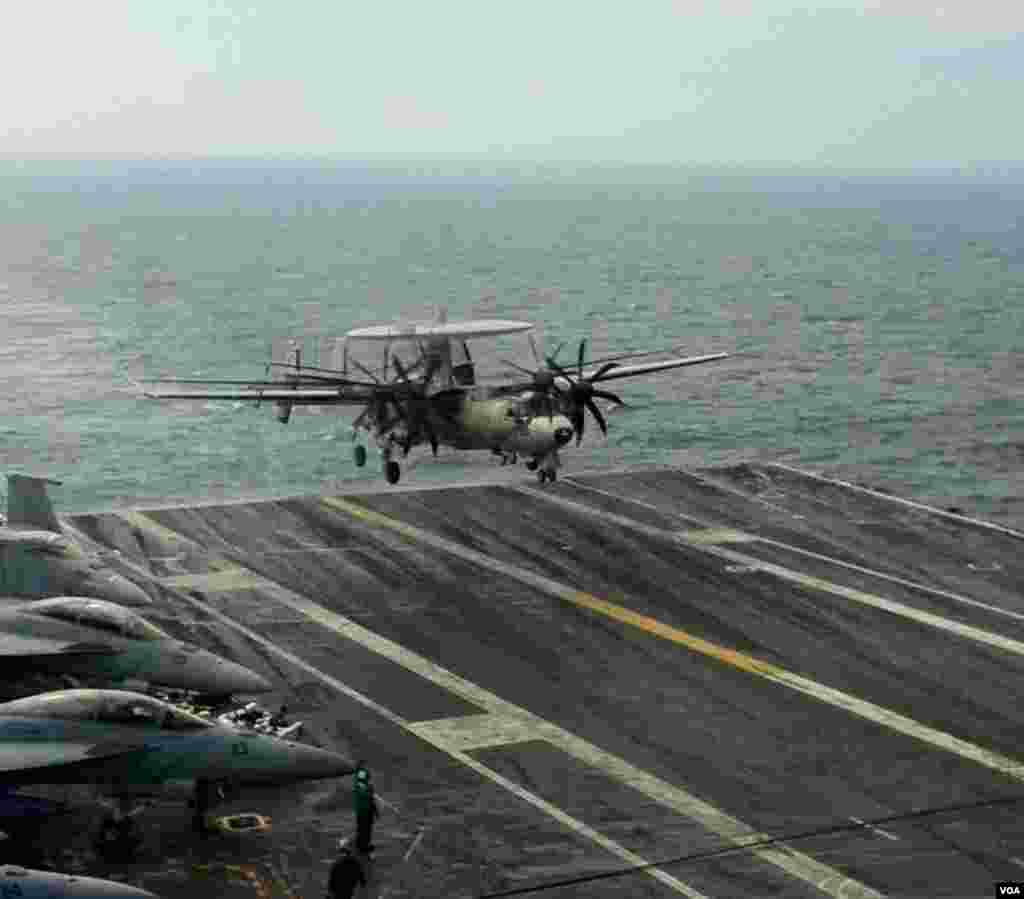
4/6An E-2 "Hawkeye" early warning/battle management aircraft lumbers onto the wet deck of the USS George Washington in the Yellow Sea, June 24, 2012. (VOA/S. Herman)
In a show of force that South Korea's military says is meant as a warning to North Korea, a U.S. naval carrier strike group is conducting maritime maneuvers with South Korea off the coast of the tense peninsula. The USS George Washington is leading its carrier strike group, part of a flotilla of 10 warships and submarines.
Show moreShow less
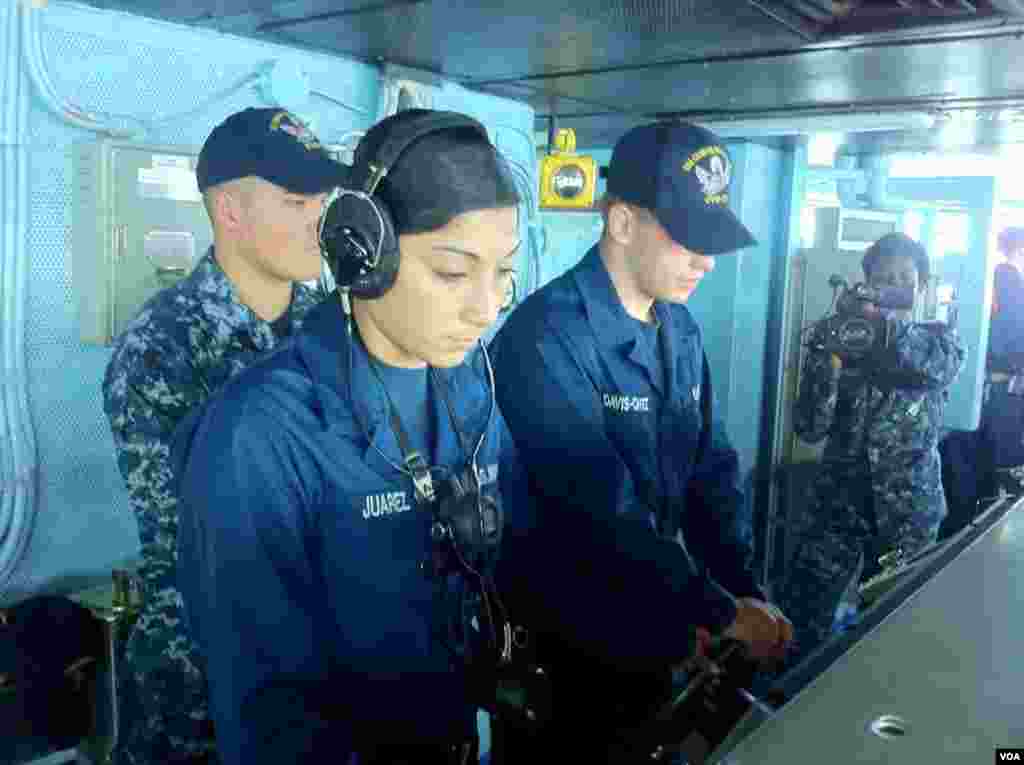
5/6Crew members of the USS George Washington on the navigation bridge steer the aircraft carrier in the Yellow Sea, June 24, 2012. (VOA/S. Herman)
In a show of force that South Korea's military says is meant as a warning to North Korea, a U.S. naval carrier strike group is conducting maritime maneuvers with South Korea off the coast of the tense peninsula. The USS George Washington is leading its carrier strike group, part of a flotilla of 10 warships and submarines.
Show moreShow less
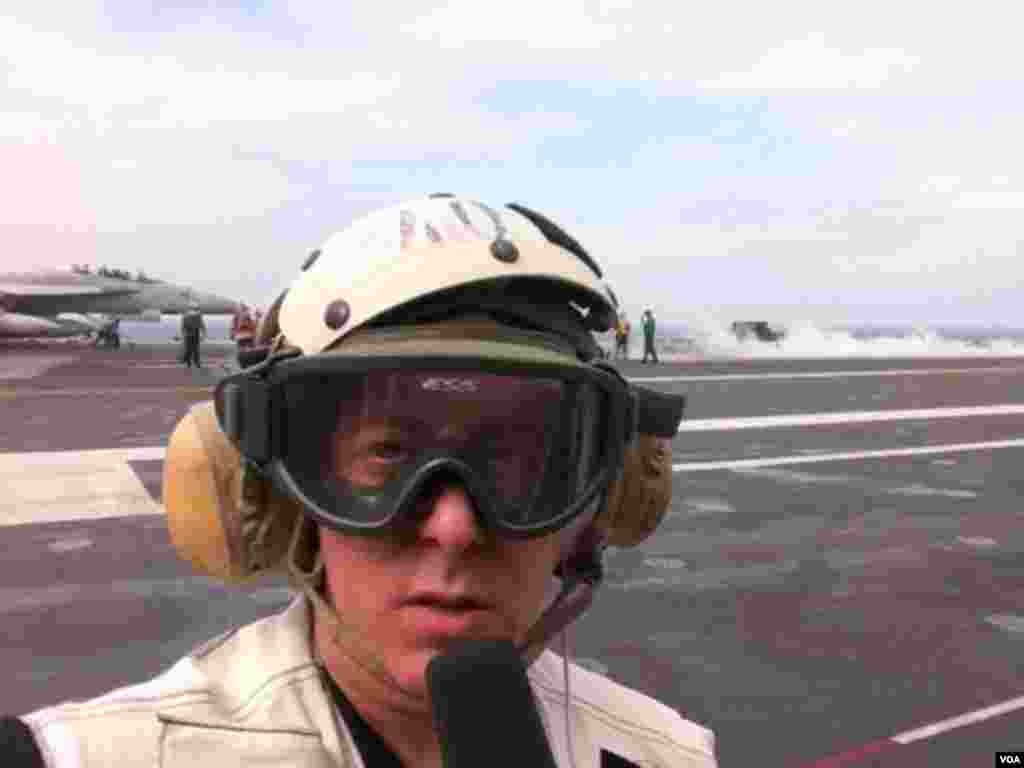
6/6VOA Correspondent Steve Herman reporting from the windy flight deck of the USS George Washington as an F-18 fighter jet prepares to take off in the Yellow Sea, June 24, 2012.
In a show of force that South Korea's military says is meant as a warning to North Korea, a U.S. naval carrier strike group is conducting maritime maneuvers with South Korea off the coast of the tense peninsula. The USS George Washington is leading its carrier strike group, part of a flotilla of 10 warships and submarines.
Show moreShow less
Previous slide
Next slide
While U.S. Navy officers are keeping silent on the scenario for this unnamed exercise, their South Korean counterparts indicate it simulates searching for and destroying North Korean submarines and tracking a long-range missile launch from the North.
Such a launch was conducted on April 13. What Pyongyang described as a peaceful attempt to place a observation satellite into orbit was widely seen as a test of ballistic missile technology meant to give it the capability of delivering a nuclear warhead across the Pacific. The rocket broke up minutes after launch and its parts fell into waters close to where these naval maneuvers are now being held.