News / Middle East

US Envoy Visits Libya Following Ambassador's Death

Libyan President Mohammed el-Megarif speaks during a memorial service for U.S. Ambassador to Libya, Chris Stevens, and three consulate staff killed in Benghazi on Sept. 11, in Tripoli, Libya, September 20, 2012.
TEXT SIZE - +
VOA News
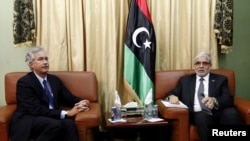
U.S. Deputy Secretary of State William Burns is in Libya for meetings with top officials about last week's deadly attack at the U.S. consulate in Benghazi.

Burns also is attending a ceremony honoring U.S. Ambassador Christopher Stevens and the three other American diplomats killed in the attack. The incident took place during a protest against an anti-Islam video that was privately produced in the United States.
Libya's Prime Minister Mustafa Abu Shagour (R) meets visiting U.S. Deputy Secretary of State William Burns in Tripoli, Libya, September 20, 2012.Libya's Prime Minister Mustafa Abu Shagour (R) meets visiting U.S. Deputy Secretary of State William Burns in Tripoli, Libya, September 20, 2012.
x
Libya's Prime Minister Mustafa Abu Shagour (R) meets visiting U.S. Deputy Secretary of State William Burns in Tripoli, Libya, September 20, 2012.
The Reuters news agency reports that Libya's foreign minister, Ashor Bin Khayyal, again apologized for the attack and told Burns that Ambassador Stevens was a "friend of Libya."

On Wednesday, a senior U.S. counterterrorism official called the incident a "terrorist attack."
National Counterterrorism Center Director Matthew Olsen told a Senate committee that the assault was "an opportunistic attack" that "evolved and escalated over several hours."

Olsen said there were indications that al-Qaida or an la-Qaida-linked group was involved in the incident, but that there has been no evidence of advance planning.

U.S. Secretary of State Hillary Clinton is expected to discuss the attack with lawmakers Thursday, during a private intelligence briefing. On Tuesday, she said the State Department had no actionable intelligence the attack was planned or imminent.

Some information for this report was provided by AFP and Reuters.

You May Like

Karzai to Discuss Enhancing Defense Ties with India

Afghanistan looking for more military aid as it prepares for withdrawal of NATO forces by next year More

India, China Pledge to Overcome Border Tensions

Indian prime minister and Chinese premier attempt to move past tense standoff in the Himalayas during Delhi talks More

Burmese President Opens US Visit with VOA Town Hall Meeting

Ahead of his meeting with President Obama Monday, Thein Sein answered questions on human rights and economic development in his country More

This forum has been closed.
Comment Sorting
Comments
     
by: Optimist from: Everywhere
September 20, 2012 4:55 PM
It is sad to see a good man killed, at the same time the amount of support pouring from Libya and beyond makes one feel humanity is still out there.

R.I.P. Chris Stevens


by: Briny from: USA
September 20, 2012 3:53 PM
Secretary Clinton sends an underling to represent the US at a memorial for its murdered Ambassador and his staff. The shrill, persistent denial of the nature of the succesful strike continues to be her official policy. This is American foreign policy at its lowest ebb since the fall of Teheran.

Featured Videos

Your JavaScript is turned off or you have an old version of Adobe's Flash Player. Get the latest Flash player.
Video

Video Valley Fever Raises Concerns in California, Arizona

A longstanding health problem in California's Central Valley has worsened in recent years, leading health officials to order the relocation of 3,000 prisoners from two state prisons. But the disease affects much of the population in some rural communities and, Mike O'Sullivan reports, while it often goes unnoticed, it sometimes can be devastating for patients.