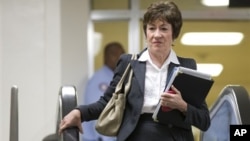
A U.S. senator says she will not support U.N. ambassador Susan Rice for secretary of state without more information on her initial account of the deadly attack on the U.S. consulate in Benghazi, Libya.
Republican Susan Collins of Maine voiced concerns about Rice's remarks on the Benghazi attack, after a closed-door meeting Wednesday in Washington. She said Rice decided to play "what was essentially a political role at the height of the presidential election" by going on American talk shows to present the Obama administration's position.
Collins, known for her moderate views, is considered crucial to White House hopes of getting Rice confirmed as secretary of state.
A few days after the September 11, 2012 attack on the consulate, Rice said initial intelligence assessments pointed to a "spontaneous" demonstration provoked by an anti-Islam video. She said the demonstration attracted heavily armed militants.
Rice said it was her "best assessment" the strike was not pre-planned.
U.S. intelligence officials later told Congress the Obama administration knew several days before Rice's remarks it was a terrorist attack.
In a statement Tuesday, Rice said she had no intention of misleading the American people in her comments about the Benghazi attack. She said information about demonstrations in talking points provided by the intelligence community were incorrect.
The statement followed her meeting with Republican Senators John McCain, Lindsey Graham and Kelly Ayotte. The three lawmakers said they remain disturbed by Rice's account of the Benghazi attack.
Rice is holding closed-door meetings this week with lawmakers. The meetings are seen as a bid by Rice to gain congressional support for a possible appointment as President Barack Obama's next secretary of state.
If nominated, she would have to be confirmed by the Senate to assume the post.
Republican Susan Collins of Maine voiced concerns about Rice's remarks on the Benghazi attack, after a closed-door meeting Wednesday in Washington. She said Rice decided to play "what was essentially a political role at the height of the presidential election" by going on American talk shows to present the Obama administration's position.
Collins, known for her moderate views, is considered crucial to White House hopes of getting Rice confirmed as secretary of state.
A few days after the September 11, 2012 attack on the consulate, Rice said initial intelligence assessments pointed to a "spontaneous" demonstration provoked by an anti-Islam video. She said the demonstration attracted heavily armed militants.
Rice said it was her "best assessment" the strike was not pre-planned.
U.S. intelligence officials later told Congress the Obama administration knew several days before Rice's remarks it was a terrorist attack.
In a statement Tuesday, Rice said she had no intention of misleading the American people in her comments about the Benghazi attack. She said information about demonstrations in talking points provided by the intelligence community were incorrect.
The statement followed her meeting with Republican Senators John McCain, Lindsey Graham and Kelly Ayotte. The three lawmakers said they remain disturbed by Rice's account of the Benghazi attack.
Rice is holding closed-door meetings this week with lawmakers. The meetings are seen as a bid by Rice to gain congressional support for a possible appointment as President Barack Obama's next secretary of state.
If nominated, she would have to be confirmed by the Senate to assume the post.