


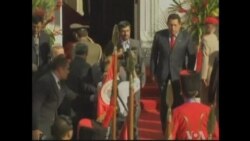

Venezuela’s President Hugo Chavez, who died Tuesday, developed a close relationship with the leaders of Iran, despite Western sanctions on Tehran because of its controversial nuclear program. Chavez and Iranian leader Mahmoud Ahmedinejad visited each other, and called themselves allies, friends and even brothers. It was a friendship that was watched closely by many countries, especially the United States.
The relationship between Iran and Venezuela began in the 1960s, in the early days of OPEC, the Organization of Petroleum Exporting Countries. But it was during Hugo Chavez’s presidency that strong ties were formed.
Iran’s nuclear program was a catalyst. Iran says its nuclear aims are peaceful; the West fears it is developing weapons.
In the face of international sanctions, Iran turned to Venezuela, one of its few allies, to break its diplomatic isolation, find new strategic resources, and undermine U.S. influence.
“In Venezuela, the PDVSA, the national oil company of Venezuela, continues to have relations with Iran in ways that break the embargo, that is the sanctions that the United Nations has imposed because of the Iranian nuclear program,” said Christopher Sabatini, with Americas Society/Council of the Americas.
Since the 1980s, the Iranian-backed Hezbollah faction in Lebanon has expanded its operations in Latin America, primarily fundraising, through ties to the illegal trade in drugs and pirated goods. The U.S. considers Hezbollah a terrorist organization.
In Latin America, Chávez’s Venezuela and other anti-American governments opened their arms to Hezbollah and Iran.
“State sponsors of terrorism - Iran is included in that list. And so we are looking at how Iran is gaining influence in the Americas, through instruments of, in particular, economic power,” said Celina Reauyo, National Defense University.
The two countries also signed bilateral accords and created committees on cultural and educational cooperation. Some regional analysts saw them as another Iranian tool for gaining influence in the region.
"If you recall the attacks in 1992 and 1994 on the Israeli Embassy and the Jewish cultural center [in Buenos Aires, Argentina], there had been ‘cultural’ cooperation for 10 years before the attacks. There was a cultural center run by Iranian diplomats, who were doing the same sorts of things: bilateral accords and intercultural exchanges,” said Joseph Humire, of the Atlas Economic Research Foundation.
While close ties between Tehran and Caracas have been useful to both countries, with Chavez’s death, that much-watched political romance, may well be set to change, as Tehran loses a key supporter.
The relationship between Iran and Venezuela began in the 1960s, in the early days of OPEC, the Organization of Petroleum Exporting Countries. But it was during Hugo Chavez’s presidency that strong ties were formed.
Iran’s nuclear program was a catalyst. Iran says its nuclear aims are peaceful; the West fears it is developing weapons.
In the face of international sanctions, Iran turned to Venezuela, one of its few allies, to break its diplomatic isolation, find new strategic resources, and undermine U.S. influence.
“In Venezuela, the PDVSA, the national oil company of Venezuela, continues to have relations with Iran in ways that break the embargo, that is the sanctions that the United Nations has imposed because of the Iranian nuclear program,” said Christopher Sabatini, with Americas Society/Council of the Americas.
Since the 1980s, the Iranian-backed Hezbollah faction in Lebanon has expanded its operations in Latin America, primarily fundraising, through ties to the illegal trade in drugs and pirated goods. The U.S. considers Hezbollah a terrorist organization.
In Latin America, Chávez’s Venezuela and other anti-American governments opened their arms to Hezbollah and Iran.
“State sponsors of terrorism - Iran is included in that list. And so we are looking at how Iran is gaining influence in the Americas, through instruments of, in particular, economic power,” said Celina Reauyo, National Defense University.
The two countries also signed bilateral accords and created committees on cultural and educational cooperation. Some regional analysts saw them as another Iranian tool for gaining influence in the region.
"If you recall the attacks in 1992 and 1994 on the Israeli Embassy and the Jewish cultural center [in Buenos Aires, Argentina], there had been ‘cultural’ cooperation for 10 years before the attacks. There was a cultural center run by Iranian diplomats, who were doing the same sorts of things: bilateral accords and intercultural exchanges,” said Joseph Humire, of the Atlas Economic Research Foundation.
While close ties between Tehran and Caracas have been useful to both countries, with Chavez’s death, that much-watched political romance, may well be set to change, as Tehran loses a key supporter.