



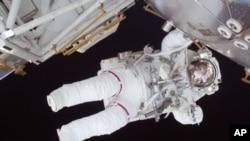
Veteran NASA astronauts gathered in Chicago to mark the 40th anniversary of the Apollo 13 mission. Despite a catastrophic explosion in 1970, Astronauts Jim Lovell, Fred Haise, and Jack Swigert safely returned to Earth. The Adler Planetarium's anniversary celebration brought several Apollo astronauts together at a time when President Obama is planning to cut funding for NASA programs to return to the moon, while investing in other technologies and a massive rocket that could take astronauts further out into space, but with no planned destination yet.
Apollo 13 was so historic that it continues to captivate the imagination of people young and old.
More than 500 people packed an auditorium in Chicago to hear how NASA astronauts and flight controllers successfully brought the 1970 mission home after an explosion crippled the spacecraft.
The continued interest in the mission, and the Apollo program in general, is no surprise to Jim Lovell, the man who helped make Apollo 13 a "successful failure." "The twentieth century, the last century, the one positive aspect of that century was the flights to the moon and the space program," he said.
Lovell and fellow astronauts Fred Haise and Jack Swigert returned to Earth 40 years ago. For Fred Haise, it was the last journey into space.
"It surprises me from the way I felt at the time that we haven't been to Mars," Haise said.
Apollo 13 was also Lovell's last trip to space. He worries about NASA's focus. "They're looking at putting money into various programs at NASA but not having any goals. Not having anything that they're striving for," he said. "Not going back to the moon or trying to go to Mars, or anything else."
Lovell, along with Neil Armstrong, and the last man on the moon Eugene Cernan, recently sent a letter to President Barack Obama to express their opposition to his proposed budget for NASA. That budget would end funding for the Constellation program, which would have returned U.S. astronauts to the moon as a stepping stone to Mars.
After three more Shuttle missions to the International Space Station this year. NASA plans to retire the shuttle fleet, bringing US manned space flight to an end, for the forseeable future.
"It's devastating to the space program if it's approved by Congress, and I really hope that more level heads will prevail. I don't think they've looked very far into the futre. There's no vision to it," Cernan said. "There's no goal. There's no challenge."
"Obviously there are a lot of people that are unhappy about the potential of altering the future of space flight," Buzz Aldrin said. Aldrin was the second man to step foot on the moon during the Apollo 11 mission in July 1969. He thinks NASA should focus on getting to Mars, not going to the moon under the Constellation program. "Why should we do something when we've already done it," he said.
"Going to the moon or going to Mars is about as interesting to people as say going to Antarctica," Bill Anders said. He was part of the 1968 Apollo 8 mission, also with Jim Lovell. It was the first manned mission to orbit the moon. "NASA has been burdened with a lack of enthusiasm by the taxpayers," he stated.
Anders says the Space Shuttle program and the International Space Station have been a burden on taxpayers. Though he favors an end to the shuttle program, he is upset there will be no other U.S. spacecraft to get astronauts to the Space Station. "I am frankly embarrassed as an American after beating the Russians to the moon, now we have to hitch hike rides back," he said.
Three more Space Shuttle missions are scheduled for this year.
The end of the Space Shuttle and the cancellation of the Constellation program, will cost 7,000 people their jobs at the Kennedy Space Center in Florida.
Despite the cuts, President Obama's proposed budget increases NASA's funding by $6 billion over the next five years. Most of the money will go towards working with industry on new technologies to make human space flight safer.