


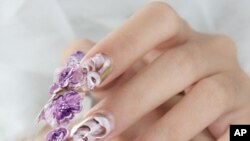
Fashion nails have provided a tried and true path to the middle class for thousands of immigrants in the United States, but today the industry is at a crossroads. Low prices, which allowed Vietnamese-Americans to dominate the $6 billion industry, are proving unsustainable and forcing salon owners to innovate new ways of doing business.
Trang Nguyen, who came to the U.S. in 1980, exemplifies the success Vietnamese-Americans have enjoyed in the nail business. Like most Vietnamese refugees, he arrived with virtually nothing and spoke very little English. After a stint as a hair stylist, he found his calling doing nails, a skill he learned from a relative who owned a salon.
Nguyen now owns Odyssey Nail Systems, a multinational company that sells nail products and offers training to salon owners. His drive to succeed is obvious - Nguyen has nabbed four world championship titles in nail artistry as well as numerous other awards along the way.
Odyssey Nail Systems
Nail artist Trang Nguyen would like to see more Vietnamese-American nail salon owners have passion for their work.
But Nguyen is concerned the industry that gave him a start in a new country is in trouble because of old habits.
"The new generation doing nails needs to have passion," he said. "They need to be really proud to be a nail artist."
Early days
The history of Vietnamese-Americans in the nail and beauty business dates back to 1975, when actress Tippi Hedren, most noted for her role in Alfred Hitchcock’s “The Birds,” arranged for 20 refugees from Vietnam to receive training as manicurists.
Those 20 women became the core of a nationwide industry, which now includes tens of thousands of nail salons operated by Vietnamese-Americans.
According to the trade publication Nails Magazine, Vietnamese-Americans make up 40 percent of the U.S. nail industry.
Early on, their main edge over competitors was price. They could charge less because their workers were willing to accept less pay. This meant that with a relatively small amount of money, basic English skills and some cosmetology training, Vietnamese immigrants could open up a salon, count on a steady flow of customers and earn enough money to own a home and educate their children.
But as the market has become more saturated, Vietnamese salon owners have found themselves knowing only one way to compete: slashing prices. The cycle of constant cutting is proving to be unsustainable over the long run.
Diversifying the approach
Duyen Hang, who used to own 25 nail salons in Florida, now spends most of her time consulting salon owners. She says they need to think of new ways to compete.
“They should learn more than just trying to lower the price,” she said. ”Any mom and pop can open a shop, but these days, almost 50 percent have problems. Many are [running the business] the same as 20 or 30 years ago."
Nguyen agrees.
“They focus on getting people in and out. It’s like a machine. They forget it's a service business. You can’t do that anymore," he said. "It’s easy to get the customer in one time with a cheap price, but are they coming back? Are they coming back with friends?”
Ripple effect
Failure to innovate in the nail business could have negative ripple effects throughout much of the Vietnamese-American community.
At a recent best practices seminar organized by the Vietnamese-American National Chamber of Commerce and held in the Washington, D.C. suburb of Falls Church, Virginia, many of the attendees weren’t even in the nail industry. They were members of the community affected by its success or failure.
“The nail business affects my business a lot,” said Thai Hung Nguyen, a real estate agent who said 60 to 65 percent of his clients are Vietnamese-Americans. “If they start losing money, they can't afford the mortgage.”
He was interested in seeing if the industry can revive and reinvent itself, and if so, what the future will be.
Customer is king
Customer service will be the key, said both Nguyen and Hang.
“Price is important, but it’s not more important than service or quality,” said Hang. She advises salons to make small changes like creating a frequent customer reward system, creating an inviting environment or making sure everyone in the shop also has their nails done.
John Ho, who owns Yvonne’s Day Spa in Northern Virginia, is making an effort to do things differently.
He and his wife opened Yvonne’s 16 years ago and then followed it with two other salons. Ho developed the Doctor Fish pedicure, which involves letting little fish swimming in a tank pick the dead skin off customers’ feet while they sit in a massage chair. He has even appeared on a variety of popular American television programs promoting his method.
Ho admits his prices are high compared to the numerous other salons nearby, but he says business is good because he delivers quality, offers a variety of treatments and procedures and never rushes customers.
AP Photo/Jacquelyn Martin
Patsy Fisher, 42, of Crofton, Md., center, checks on the progress of KaNin Reese, 32, of Washington, with Tracy Roberts, 33, of Rockville, Md., left, as they indulge in a fish pedicure treatment at Yvonne Hair and Nails salon in Alexandria, Va. on Thursday July 17, 2008.“We get a lot of repeat customers,” he said, even though “around here there are more Vietnamese-owned nail salons than McDonald’s.”
Some of his customers are extremely loyal.
Mary Miller, who used to live near Yvonne’s but has relocated to Tennessee said she comes in for a pedicure whenever she’s back in town, citing all the little extras that are thrown in such as hand rubs, feet rubs and temple rubs.
“They’re great!” she said. “I’ve been coming since they opened. I go to a place back home, but they’re not like this!”
Hang has faith that more Vietnamese salon owners can, like Ho, adapt to the new climate.
“Most Vietnamese-Americans do a great a job,” she said “Their hands are magic.”