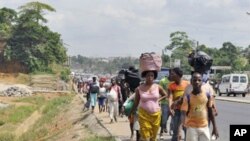



Civilians in Ivory Coast's commercial capital are fleeing a week of fighting between supporters of the country's rival governments. The incumbent president's youth leader wants to block the movement of all U.N. peacekeepers.
Armored personnel carriers of riot police rolled down the main street of Abidjan's Abobo neighborhood Friday, after a week of fighting between security forces loyal to incumbent president Laurent Gbagbo and supporters of the United Nations-certified winner of the election, former prime minister Alassane Ouattara.
Abobo residents say sporadic gunfire overnight ended about 5 a.m. local time, and that many businesses opened for the first time since last Saturday. Men built wooden beds. Women sat in the shade selling peanuts.
Any sense of normalcy in Abobo, however, is disrupted by the steady stream of people leaving. Lines of families carrying suitcases wait for taxis. A boy carrying a chicken in a cardboard box walks along the road with his mother, who is carrying their clothes in a rice bag on her head.
Gbagbo's government says Ouattara's supporters are attacking security forces in Abobo, allegedly organized by former rebels into what local newspapers are calling "mystical commandos." The units are said to be led by Commandant "Funyon," the Mandingo word for wind, because, the newspapers say, he is felt but never seen.
Yves Doumbia, spokesman for Ouattara's party in Abobo, said the uprising here has not been organized by the party or the former rebels. He said the fighting has been carried out by young men opposed to Gbagbo's rule, who have armed themselves with weapons left behind by Gbagbo security forces.
Gbagbo youth leader Charles Ble Goude said the fighting is being backed by U.N. peacekeepers. Goude said the United Nations is no longer in Ivory Coast for peace. He said the United Nations is there to make war in place of the rebels. He said they are supporting rebel radio broadcasts and helping to transport rebel forces. This, he said, can not continue.
Goude told thousands of Gbagbo supporters Friday that they should organize themselves to block the movement of all U.N. peacekeepers in Ivory Coast.
U.N. troops guard the hotel where Ouattara has been living since November's vote.
With African Union heads of state expected to announce their peace plan for Ivory Coast Monday, Ouattara's prime minister said Ivorians should expect nothing from that mediation and should instead rise up in an Egyptian-style revolt against Gbagbo.
The West African regional alliance says it is willing to use force to remove Gbagbo. But Nigerian Foreign Minister Odein Ajumogobia said that is more likely to be part of an economic blockade rather than combat troops.
"Legitimate force, as the expression goes, does not necessarily or indeed imply an invasion or a shooting urban war as you have described it," he said. "Force implies exactly that, but you are using measures other than diplomacy and dialogue to bring about a result. An air and naval blockade, for example, to give teeth to sanctions that have been approved would be part of what I would describe as legitimate force. But these steps, in my view, can only be taken pursuant to appropriate sanctions endorsed by the U.N. Security Council."
With more than 30,000 Ivorian refugees already in Liberia, Ajumogobia said West African leaders are well aware of the conflict's regional implications.
"I think a huge humanitarian crisis is at stake," he said. "I talked about large immigrant population. If there is civil unrest or worse, civil war in the country, the implications for the sub-region are enormous and we will all then be engaged in trying to solve a problem we could have prevented."
Clashes between Ouattara and Gbagbo supporters now have spread to the political capital, Yamoussoukro. The United Nations says fighting between government troops and rebels near the border with Liberia is a dangerous escalation of the conflict that violates a six-year-old ceasefire.
Civilians Flee Fighting in Ivory Coast's Commercial Capital