



NAIROBI—Frequent grenade and bomb attacks have plagued Kenya ever since it invaded Somalia in October of last year. The government blames al-Shabab for the insecurity, and Kenyan police have responded by conducting regular sweeps of Nairobi's predominantly ethnic-Somali suburb of Eastleigh, searching for supporters of the Islamist group.
Clashes between Somali and Kenyan youth erupted in Eastleigh earlier this week, shortly after a bomb ripped through a minibus on Sunday, killing seven and wounding dozens of others. Kenyan police stepped in, firing bullets and teargas to disperse the rioting crowds.
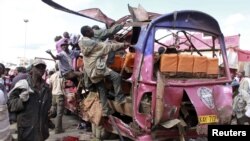
The recent crackdown on ethnic-Somalis, with the aim of rooting out suspected al-Shabab cells, has alienated one of Kenya’s largest minority communities, and now some Kenyan officials are conducting political damage-control.
On Thursday afternoon, a convoy of Kenyan politicians lumbered through Eastleigh's potholed roads to hold a peace rally.
“We are united in our diversity, that is our strength as Kenyans," Prime Minister Raila Odinga proclaimed via loudspeaker, standing up through the moonroof of a car.
But not everyone in the surrounding streets would hear the decree. Nearby, in one of Eastleigh’s many shopping malls, store owner Istahil Hersi did not attend.
Her cousin was killed during Monday’s rioting. Eyewitnesses, she says, saw men in uniform shoot 25-year-old Abdullahi Aideed Mohammed, a recent college graduate. Relatives rushed him to the hospital but were too late.
“They said he died already,” says Hersi, adding that police refused to release Abhdullahi’s body to relatives unless they signed a document pledging they would not pursue legal action.
Though police have not commented on the allegation, Hersi describes it as blackmail.
“They say, 'if you tell your lawyer, if you go to court, we can’t give you the body',” she says.
Two stalls down from Hersi is cashier Mohammed Aralle Mohammed, whose apartment was stormed by police after Monday's riots. Shortly after midnight, officers arrested his brother, Farhan, accusing him of belonging to al-Shabab.
“Either they say you’re involved in a gang or you’re part of al-Shabab," he says, explaining that Farhan is being held in a prison in Nairobi’s industrial area with around 60 others from Eastleigh, according to his brother’s estimates.
“Yesterday and the day before I went to the court, and they said everyone must pay 100,000 Kenyan shillings for each person arrested above the age of 18,” says Mohammed.
He cannot afford to pay the bond and does not know when Farhan will be released, and he claims police did not ask his brother, who holds refugee status, for any documents before arresting him.
Rights group weighs in
Human Rights Watch researcher Otsieno Namwaya says police are becoming more heavy-handed.
“Even Kenyan-Somalis with papers, like national identity cards, are being detained," he says. "To a Kenyan-Somali, [it means] that a national identity card is no longer a guarantee that you will be treated as a Kenyan.”
Manwaya claims the number of arbitrary arrests is growing.
“The Kenyan police do not bother to investigate to determine who were behind it," he says. "They will say it is al-Shabab. But when you ask them, what is the evidence it is al-Shabab and not just common criminals, they don't show you any evidence.”
Police could not be reached for comment. Residents estimate hundreds were arrested during this week’s raids.