



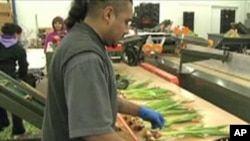
Spring means watching flowers bloom and one amazing place to watch this happen can be found near Stevensburg, Virginia, just 113 kilometers (70 miles) outside of Washington. At Fresh Tulips USA, they pick 4.5 million of these buds every week, making it one of the largest greenhouses in the world.
Coen Haakman is a Dutch tulip farmer who moved his tulip-growing operation to the United States in 2004. In just seven years his company has become one of the world’s largest tulip producers.
"We are a tulip factory," says Haakman. "We employ about 100 employees. We are open from about from 7 a.m. in the morning until 3 a.m. at night."
Haakman’s original goal was to sell about five million tulips a year. His annual sales are now at 45 million with the company shipping 400,000 tulips a day. The blooms travel to market across half the United States - from Boston down to Florida, and across to Texas.
Besides the sheer scale of this operation, there’s another interesting fact. All these tulips are grown without using soil.
"We grow them all hydroponically. All our bulbs grow without any soil, or chemicals or pesticides," says Haakman. "The bulb itself has so many nutrients in it that it can grow by itself. It only needs water and some fertilizer to get to a full product and I think that is pretty innovative."
It’s not easy to grow 45 million tulips a year. It requires running a tight ship and one of the most modern facilities.
"The greenhouse is about 40,000 square meters," says Haakman. "We have about eight million tulips in the greenhouse itself. It is fully automated. We have screens on top so we can open up the complete roof. It is all glass, hardened glass. We've got energy curtains, shade curtains, heating, water. Everything is prepared here to grow lots of tulips."
Throughout the greenhouse, watering booms slowly water the entire bay while workers are busy planting, picking and packaging the tulips.
Normally, the facility ships about 400,000 tulips a day. But that number goes up dramatically around the U.S. Mother’s Day holiday in May. Haakman says preparations for Mother’s Day start a year in advance.
"If we don’t prepare in May for what we need the next year in May, we will be too late. I need roughly five-six million tulips for Mother’s Day and if I don’t prepare that on time, I will not have them."
Haakman says it’s common for large-scale tulip production to be done hydroponically. But he says there are only about five other tulip-growing operations in the world as large as his.