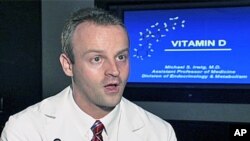
Experts increasingly believe that Vitamin D has a multidimensional role in promoting health. Research is now showing that vitamin D can affect mostly every part of the body and lower the risk for many diseases, including cancer. At the same time, low levels of Vitamin D can have serious consequences, even for infants.
Newborns are known to be at higher risk for respiratory infections.
Now new research, led by Massachusetts General Hospital, has found a link between low Vitamin D in infants and respiratory infections.
The research found that wheezing can worsen in early childhood if infants have low levels of vitamin D.
But it stops short of confirming a link with chronic asthma.
Doctors are also finding connections between vitamin D and healthy pregnancies.
Another recent study has shown that pregnant women can reduce their chances of pregnancy and birth-related complications if they take 4,000 International Units of vitamin D every day.
Dr. Michael Irwig, at George Washington University Medical School, lectures frequently on Vitamin D.
"There have been some studies showing that if you give pregnant women 4,000 units of Vitamin D a day, their rates of complications in pregnancy are much decreased," Irwig said. "If you look at things like infection, pre-term delivery, even gestational diabetes, they are all reduced with giving pregnant women higher doses of vitamin D."
Routine prenatal vitamins do not provide enough Vitamin D, according the study, conducted by Massachusetts General and University of Colorado at Denver.
It found that seven out of every ten pregnant women in the United States are not getting enough Vitamin D.
Also women with darker skin, those who cover their skin for religious and cultural reasons, and those living in areas with longer winter months are at risk for low Vitamin D.
That's because Vitamin D is produced by our bodies when we absorb sun through our skin.
Many people also block sun light with sunscreen.
And some of the Vitamin D ingested gets trapped in body fat and is therefore unavailable.
Doctors say many people don't have enough vitamin D.
"Vitamin D has become a very hot topic in medicine now as we are discovering very high levels of vitamin D deficiency in our population, not only in the U.S. but worldwide," Irwig said
Vitamin D is also essential for the body's absorption of calcium.
The US Institute of Medicine recommends that infants should receive 400 Units of vitamin D per day, and others about 600 Units. It recommends that people 71 or older could need 800 Units per day.