News / USA

'War of 1812' Flag Still Inspires After 200 Years

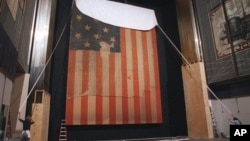
In this Nov. 20, 1998 file photo, workers at the Smithsonian's National Museum of American History cover the flag that inspired "The Star Spangled Banner," prior to the flag's restoration.
TEXT SIZE - +
Ted Landphair
This is a really big year at Fort McHenry, a star-shaped fortification overlooking the harbor in Baltimore, Maryland.

Baltimore and a few other places are commemorating the 200th anniversary of the start of what Americans call the War of 1812 - even though it wasn’t finished until 1815. Fort McHenry, and an oversized flag that flew above it, played a memorable part in that war.

What is sometimes called our nation’s “Second War of Independence” against Britain was not going well for the young United States when Fort McHenry came into play in September of 1814. The British had torched the White House and Capitol in Washington, and they headed north to Baltimore.  

Their gunships pounded Fort McHenry mercilessly for 25 straight hours. If it fell, the harbor would be under British control, and so would Baltimore.
Only in America-Fort McHenry Flag
Loading
12:00:00 / -:--:--


But at dawn, as Francis Scott Key, a Washington lawyer who observed the shelling, wrote in a poem, a miraculous visage of “broad stripes and bright stars” of the U.S. flag appeared, still “gallantly streaming” over Fort McHenry.
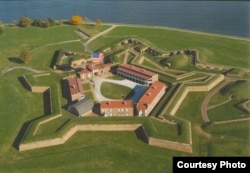
An aerial view of Fort McHenry. The 15-star flag shown is current, but it approximates the oversized flag that flew over the fort during the fateful bombardment of 1814. (National Park Service)An aerial view of Fort McHenry. The 15-star flag shown is current, but it approximates the oversized flag that flew over the fort during the fateful bombardment of 1814. (National Park Service)
x
An aerial view of Fort McHenry. The 15-star flag shown is current, but it approximates the oversized flag that flew over the fort during the fateful bombardment of 1814. (National Park Service)

Thwarted and out of ammunition, the British sailed away and Key’s verses became the words to the U.S. national anthem, “The Star-Spangled Banner.”

As for the largest battle flag ever flown at the time, which Fort McHenry’s commandant, Lt. Col. George Armistead, had ordered raised as a defiant symbol of resistance: It survived, shot full of holes. 

Col. Armistead kept it and allowed several pieces, including one of its 15 stars, to be snipped off and given away as souvenirs. 
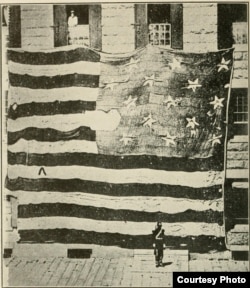
A soldier guards the original Fort McHenry. Note his size and that of the flag. (Wikipedia Commons)A soldier guards the original Fort McHenry. Note his size and that of the flag. (Wikipedia Commons)
x
A soldier guards the original Fort McHenry. Note his size and that of the flag. (Wikipedia Commons)

In 1912, what was left of the flag was presented to the Smithsonian Institution in Washington. After many restorations, it is front and center at the National Museum of American History.

And on Flag Day, June 14, this year, three red threads from the historic Fort McHenry flag were sewn into the “National 9/11” flag, a tattered remnant of an even more terrible attack on the United States by terrorists, who brought down the World Trade Center’s Twin Towers in New York on Sept. 11, 2001.  

That 9/11 flag is currently on tour and will end up on display in the Sept. 11 Memorial that is being built at Ground Zero where the towers once stood.

The threads came from seven small patches of the original Fort McHenry flag that are held by the Star-Spangled Banner House Museum in Baltimore.

You May Like

South Africa to Host World's Biggest Telescope

South Africa competed against Australia to host the telescope, the final decision was to split the SKA between the two countries More

Report: Global Warming Could Reverse Development

World Bank study says warmer climates threaten advances and could exacerbate poverty in world’s poorest regions More

Inmates Fight Fires, Gain Skills for Life After Prison

In California, physically fit inmates with no history of violent crimes can train, work as firefighters while serving their time More

This forum has been closed.
Comment Sorting
Comments
     
by: TruConserv from: AZ
September 18, 2012 3:21 PM
JD - chill out. This isn't a story about the War of 1812, it's about a flag. The sole line in the story about the war itself is factually correct, it is sometimes called the Second War of Independence.

Next time, give some time to reading comprehension before whining about how a story is the story YOU wanted.


by: JD from: AL
September 10, 2012 12:02 PM
You obviously haven't done your research as to what the "War of 1812" really was, how badly Canada whooped us, or about how it allowed the Rothschild's to put us further in debt to Britain by established a loaned over "federal" bank that taxed and enslaved the American people to the Britains and continues to affect us in Common Trade Laws today. Do us all a favor, get a different day job, or at least start doing some "research" before you post oblivious BS.

Featured Videos

Your JavaScript is turned off or you have an old version of Adobe's Flash Player. Get the latest Flash player.
Video

Video Inmates Fight Fires, Gain Skills for Life After Prison

The western state of California is known for wildfires that can quickly burn out of control, and this year the fire season has been extremely busy. Because of the fire risk, the state has some of the most experienced firefighters in the industry. It also enlists the help of prisoners to stop the fires. VOA's Elizabeth Lee reports from southern California.