North and South Korea have increased their rhetoric against one another as the South conducts more military exercises.
North Korea said Thursday it is ready to use its nuclear deterrent in what it called a "sacred war" if it is provoked. Armed forces minister Kim Yong Chun said that South Korea was deliberately pushing the situation to the brink of war.
South Korean President Lee Myung-bak visited with soldiers at a base near the border Thursday, saying the South should answer any new attack from the North with a powerful counter-attack. Mr. Lee said he had been mistaken to think patience can bring peace to the Korean peninsula.
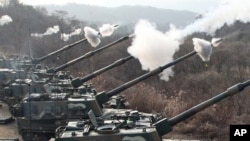
South Korean air and ground forces staged their latest military exercise Thursday, pounding a snowy valley just 30 kilometers from the border with bombs and munitions from tanks, artillery, rocket launchers and F-15 warplanes.
Former U.S. diplomat Bill Richardson who just returned from North Korea told VOA Thursday that the situation is so tense that there needs to be more diplomacy. He said he would like to see the resumption of six-party talks involving North Korea and other regional powers. Richardson described the situation on the Korean peninsula as a "powder keg" and and said what is important now is re-engagement.
Richardson, who now serves as governor of the U.S. state of New Mexico, made the trip to North Korea in a private capacity.
The White House said earlier this week that North Korea is not even "remotely ready" for the resumption of six-party talks.
South Korean military officials said the combined air and ground exercise at a firing range at Pocheon was the largest of its kind ever conducted during the winter months. Local residents and a handful of reporters looked on as 800 troops with heavy weapons pounded their targets for almost three-quarters of an hour.
South Korean officials said Wednesday that the exercise, which was much larger than previous drills at the base, was organized in response to North Korea's artillery attack on Yeonpyeong Island last month. Two soldiers and two civilians were killed in the attack, which came during a South Korean live-firing exercise.
The South resumed live firing exercises from the island for the first time Monday, defying threats from the North of overwhelming retaliation. The exercise ended without incident and the North declared it was "not worth" its trouble to respond.
War Rhetoric Rises Between Koreas