News / Science & Technology

Warmer Oceans Could Mean Smaller Fish

Changes in ocean and climate systems due to global warming could lead to smaller fish. (Credit: Halseike Creative Commons)
TEXT SIZE - +
Rosanne Skirble
Summers in the Scandinavian Arctic are the warmest they've been in nearly 2,000 years, and this warming of the oceans worldwide could be leading to smaller fish, which has major implications for global fisheries, according to two new studies.  
 
Warmer oceans

William D’Andrea studies how Earth’s climate changes over time. In an article just published in the journal Geology, the associate professor at Columbia University’s Lamont-Doherty Earth Observatory charts 1,800 years of Arctic climate history, based on his analysis of sediment from a lake in the Norwegian archipelago of Svalbard.  
 
“This location hasn’t been as warm in the last 1,800 years as it has been in the last two decades,” he says.
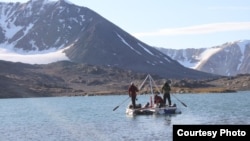
From this small platform perched atop two inflatable rafts, these scientists are able to take sediment cores from the lake floor below. (Credit: Marthe Gjerde)From this small platform perched atop two inflatable rafts, these scientists are able to take sediment cores from the lake floor below. (Credit: Marthe Gjerde)
x
From this small platform perched atop two inflatable rafts, these scientists are able to take sediment cores from the lake floor below. (Credit: Marthe Gjerde)

D’Andrea and his colleagues reconstructed that climate history by examining traces of algae in the organic material and minerals that settled to the Arctic lake bottom over the millennia.

Scientists know that algae living in cooler water produce lots of unsaturated fats. In warmer water, they produce less. By measuring the fat content in algae retrieved in lake-bottom core samples, D’Andrea was able to track the Earth’s temperature over thousands of years.
 
“So what we have are little thermometers," he says. "These algae are producing thermometers and dropping them into the sediment and leaving them behind.”

Climate Change in Warmer World
Loading
12:00:00 / -:--:--

 
D’Andrea says local air temperature records for the past 100 years match what he found in the lake-bottom sediment for the same period. He says the unique algae signatures can help scientists look into the past to see how Earth’s climate system behaves.
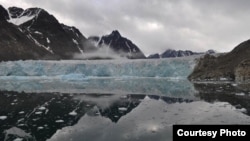
Glaciers on western Svalbard have been retreating for at least the past 100 years. The lake in the foreground can be used to study past changes in glacier activity. (Credit: William D'Andrea)Glaciers on western Svalbard have been retreating for at least the past 100 years. The lake in the foreground can be used to study past changes in glacier activity. (Credit: William D'Andrea)
x
Glaciers on western Svalbard have been retreating for at least the past 100 years. The lake in the foreground can be used to study past changes in glacier activity. (Credit: William D'Andrea)

“And once we understand that, we get a better handle on how it does behave and why it responds in certain ways to different types of forcing, whether those forcing mechanisms are based on the sun’s output or volcanic eruptions or the level of greenhouse gases in the atmosphere,” D’Andrea says.

He adds that a clear picture of our climate history is essential to making accurate projections of our climate future.

Smaller fish
 
A second new study, published in the journal Nature Climate Change, looks at how fish are responding to rising ocean temperatures.  Lead author William Cheung and colleagues at the University of British Columbia’s Fisheries Centre, used computer models to project climate-induced physical changes in more than 600 species of fish.
 
“What we find is that across different ocean basins, meaning Pacific, Indian or Atlantic oceans, we are seeing on average around 14 to 24 percent reductions in maximum body size of the fish species that we investigated by 2050 relative to now,” Cheung says.
 
As the atmosphere is warmed by heat-trapping emissions from fossil-fueled power plants, buildings and automobiles, so too is the ocean.  And in a warmer ocean, there is less dissolved oxygen available to fish, who need it for normal growth.      

“So at some point the fish will stop growing because they just cannot get sufficient oxygen to support growth in addition to maintaining their normal body function,” Cheung says.  
 
The study is the first to predict that a warmer ocean could mean smaller fish in the decades ahead.  It also suggests that global warming may exacerbate the damage to fish populations already being done through overfishing, pollution and habitat loss.
 
“If you look at the fish population that is already depleted, that their critical habitat are deteriorated, they have a smaller capacity to respond to climate change compared to fish populations that are still abundant or that they are well managed and in good condition," Cheung says. "So we need to manage our marine ecosystems effectively as well.”
 
Cheung says the study concludes that failure to curb climate-changing greenhouse-gas emissions could risk further damage to marine ecosystems, global fisheries and an essential source of the world’s food.


You May Like

South Africa to Host World's Biggest Telescope

South Africa competed against Australia to host the telescope, the final decision was to split the SKA between the two countries More

Report: Global Warming Could Reverse Development

World Bank study says warmer climates threaten advances and could exacerbate poverty in world’s poorest regions More

Video Inmates Fight Fires, Gain Skills for Life After Prison

In California, physically fit inmates with no history of violent crimes can train, work as firefighters while serving their time More

This forum has been closed.
Comment Sorting
Comments
     
by: Anonymous
October 15, 2012 2:11 PM
Charlie--
Please study some more, friend. They just explained how they have accurate records at that location going back 1,800 years (little "algae thermometers"), and there are dozens of other reliable sources of historic temperature data (cherry blossom tree dates in Japan, air trapped in ice cores in Greenland, fossilized tree rings, lake sediments, and many more).
The Earth is NOT cooling. And far more than 16ppm of CO2 were added by humans--pre-Industrial Revolution concentrations were around 275ppm. Deforestation, coal, and oil have contributed the rest.
Al Gore did not invest this science. But he and other very smart people believe it. Look up James Hansen, or Bill McKibben, or Jared Daimond--and then find one scholar of their caliber who denounces climate change. Find just one, who isn't funded by fossil fuels.
I don't think you can do it.


by: rlaqkgnl from: Yougtong dong, Suwon, S.K
October 10, 2012 3:32 AM
Then how about the whales?


by: Charlie from: North Yorkshire
October 09, 2012 12:21 PM
Accurate records only go back 100 years. I wonder what happened 1,800 years ago? Actually the Chinese sailed through the North West Passage in the 1400's and a British Nuclear submarine broke through the ice at the North pole in the Summer of 1987, before the Global Warming hysteria and Algore's $Billions. Remember, the current levels of CO2 in the atmosphere (395 ppm) only 16 parts per million are man made. That may explain why the Earth is cooling and that Antarctic Sea ice is at its greatest extent recorded. Small fish are most likely to do with over fishing and over fishing is caused by overpopulation.

Featured Videos

Your JavaScript is turned off or you have an old version of Adobe's Flash Player. Get the latest Flash player.
Video

Video Human Rights Film Festival Highlights Gender, Economic Issues

Twenty new films from around the world are screening in New York this week, as part of the 24th annual Human Rights Watch Film Festival, co-presented by the Film Society of Lincoln Center and IFC Center. The issues explored range from the rights of women, gays and the disabled, to economic justice, to political murder, torture and wrongful imprisonment. VOA’s Carolyn Weaver reports from New York.