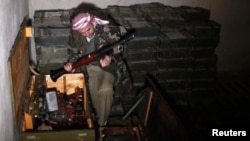
Intelligence experts believe Syria has one of the largest chemical weapons arsenals in the world. Experts ask whether the Syrian government might use these weapons against insurgents and whether the rebels could gain access to chemical weapons and use them against the Syrian armed forces.
Western analysts say Syria’s chemical weapons arsenal includes mustard gas, the more modern sarin and even VX - the most toxic of all chemical nerve agents.
Still, Leonard Spector, a chemical weapons expert [Director of the Washington-based James Martin Center for Non-Proliferation Studies] said Syria has no history of using such weapons.
“But it sure does have a history of acquiring them. This program has been going on since the 1980s - if not before,” said Spector. “And it’s been advanced from the more classic World War One chemical weapons, up to some very modern ones. They have had help from the Soviet Union originally, later on probably from North Korea and Iran.”
Syria amasses chemical weapons
Gregory Koblenz, an expert at George Mason University, said the Syrians amassed chemical weapons for a key purpose.
“Syria started its chemical weapons program in response to their conventional military inferiority compared to the Israelis and also as a counter to Israel’s nuclear program,” said Koblenz. “So these were weapons that were designed for use on the battlefield, for strategic use against foreign adversaries - it was not designed to deal with the kind of situation that Syria finds itself in today.”
Western analysts believe Syria’s chemical weapons are produced in four to eight facilities and stored in dozens of sites throughout the country. As of now, they are secure under government control.
Will Assad use chemical weapons against insurgents?
But questions remain as to whether Syrian President Bashar al-Assad will use chemical weapons against the insurgency.
Greg Thielmann, an expert with the Arms Control Association, a private research firm, said it is hard to foresee Assad using these weapons against the rebels.
“Chemical weapons are very messy and lethal and it’s not only a danger to non-combatants in a particular area, but they have a tendency to blow back on the very troops who are using them. So it’s not a very attractive weapon to use - it’s of much more value as a deterrent than it is a weapon actually used in wartime.”
Syrian opposition activists, however, have accused the government of using lethal gas to kill rebels - a charge the government denies.
Russian Foreign Ministry spokesman Alexander Lukashevich dismissed the gas use reports, saying they are designed to provoke “foreign armed intervention” into Syria’s conflict.
But Joseph Holliday, former army intelligence officer and now senior analyst at the Washington-based Institute for the Study of War, said he could see President Assad using chemical weapons against his people.
“Clearly, the chances of that happening increase as the Assad regime nears end game,” said Holliday. “Right now our deterrence, our ‘red line’ is based really on the psychology of Bashar al-Assad at this point -- that he won’t, he wouldn’t dare to use them because that would mean committing suicide. But if at some point in the future, if the rebel gains continue, and he’s backed into a corner, Bashar may decide that he’s dead either way and the risks of miscalculation increase.”
U.S. President Barack Obama has warned Damascus that there “will be consequences” if such weapons are used.
Insurgents may get chemical weapons
Experts fear that some chemical weapons might fall into the hands of the insurgents, especially those Islamist radicals fighting to oust Assad.
But analyst Holliday said the rebels will have trouble using the more sophisticated chemical weapons even if they get hold of them.
“Some of the low-end chemicals - mustard gas, chlorine - that can be put basically into a car bomb or something of that nature and used in an unconventional way. But the higher end weapons, like sarin or like VX, require specific handling and delivery that I don’t know that the rebels would have the capability to do.”
Many experts said the issue of Syria’s chemical weapons will not go away, even if peace is restored. Analysts said the best way to address the problem would be for the Syrian government to dispose of those lethal weapons under international supervision.
Western analysts say Syria’s chemical weapons arsenal includes mustard gas, the more modern sarin and even VX - the most toxic of all chemical nerve agents.
Still, Leonard Spector, a chemical weapons expert [Director of the Washington-based James Martin Center for Non-Proliferation Studies] said Syria has no history of using such weapons.
“But it sure does have a history of acquiring them. This program has been going on since the 1980s - if not before,” said Spector. “And it’s been advanced from the more classic World War One chemical weapons, up to some very modern ones. They have had help from the Soviet Union originally, later on probably from North Korea and Iran.”
Syria amasses chemical weapons
Gregory Koblenz, an expert at George Mason University, said the Syrians amassed chemical weapons for a key purpose.
“Syria started its chemical weapons program in response to their conventional military inferiority compared to the Israelis and also as a counter to Israel’s nuclear program,” said Koblenz. “So these were weapons that were designed for use on the battlefield, for strategic use against foreign adversaries - it was not designed to deal with the kind of situation that Syria finds itself in today.”
Western analysts believe Syria’s chemical weapons are produced in four to eight facilities and stored in dozens of sites throughout the country. As of now, they are secure under government control.
Will Assad use chemical weapons against insurgents?
But questions remain as to whether Syrian President Bashar al-Assad will use chemical weapons against the insurgency.
Greg Thielmann, an expert with the Arms Control Association, a private research firm, said it is hard to foresee Assad using these weapons against the rebels.
“Chemical weapons are very messy and lethal and it’s not only a danger to non-combatants in a particular area, but they have a tendency to blow back on the very troops who are using them. So it’s not a very attractive weapon to use - it’s of much more value as a deterrent than it is a weapon actually used in wartime.”
Syrian opposition activists, however, have accused the government of using lethal gas to kill rebels - a charge the government denies.
Russian Foreign Ministry spokesman Alexander Lukashevich dismissed the gas use reports, saying they are designed to provoke “foreign armed intervention” into Syria’s conflict.
But Joseph Holliday, former army intelligence officer and now senior analyst at the Washington-based Institute for the Study of War, said he could see President Assad using chemical weapons against his people.
“Clearly, the chances of that happening increase as the Assad regime nears end game,” said Holliday. “Right now our deterrence, our ‘red line’ is based really on the psychology of Bashar al-Assad at this point -- that he won’t, he wouldn’t dare to use them because that would mean committing suicide. But if at some point in the future, if the rebel gains continue, and he’s backed into a corner, Bashar may decide that he’s dead either way and the risks of miscalculation increase.”
U.S. President Barack Obama has warned Damascus that there “will be consequences” if such weapons are used.
Insurgents may get chemical weapons
Experts fear that some chemical weapons might fall into the hands of the insurgents, especially those Islamist radicals fighting to oust Assad.
But analyst Holliday said the rebels will have trouble using the more sophisticated chemical weapons even if they get hold of them.
“Some of the low-end chemicals - mustard gas, chlorine - that can be put basically into a car bomb or something of that nature and used in an unconventional way. But the higher end weapons, like sarin or like VX, require specific handling and delivery that I don’t know that the rebels would have the capability to do.”
Many experts said the issue of Syria’s chemical weapons will not go away, even if peace is restored. Analysts said the best way to address the problem would be for the Syrian government to dispose of those lethal weapons under international supervision.