


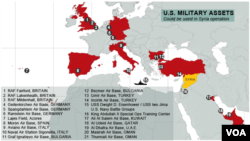
Western security experts say the U.S. military has three principal methods for carrying out a potential operation to secure or destroy Syria's suspected chemical weapons sites.
One option is to airlift U.S. ground forces into Syria with the goal of seizing and securing the sites, which are thought to be concentrated in the cities of Damascus, Hama, Homs and Latakia.
Parachuting troops
GlobalSecurity.org director John Pike said the U.S. 82nd Airborne Division could move a brigade into Syria within 12 hours of being given the task. The division is based in the East Coast state of North Carolina.
The U.S. military also has a small troop presence much closer to Syria.
U.S. media have reported that 150 military specialists were sent to Jordan earlier this year to train Jordanian forces in dealing with a possible Syrian chemical weapons crisis.
The U.S. specialists have been based at the King Abdullah II Special Operations Training Center northeast of Amman. Neither the United States nor Jordan has said whether those troops could be sent into Syria.
Navy strikes
A second option for the U.S. military is to destroy Syrian chemical stockpiles with cruise missiles fired from warships in the Mediterranean.
Two U.S. navy battle groups capable of firing those missiles are on duty in the region.
The USS Iwo Jima amphibious assault group is at sea as part of the U.S. 6th Fleet, whose area of responsibility includes the Mediterranean. Pike said that is where the group spends most of its time.
The USS Eisenhower aircraft carrier group is on duty specifically in the Mediterranean. Pike said the two battle groups likely have about 500 Tomahawk cruise missiles between them.
The USS Eisenhower also has the ability to launch warplanes into Syria. Additional U.S. warplanes could be sent into Syria from a variety of air bases that United States shares with allies in Europe and the Gulf.
Regional air bases
Two of the closest air bases to Syria are in Turkey, one of the strongest regional critics of Syrian President Bashar al-Assad. The Incirlik and Izmir bases would provide the shortest routes to the chemical weapons sites.
Pike said the U.S. Air Force also could fly some of its warplanes from bases in Western Europe to bases in Italy or Bulgaria, before dispatching them on a shorter journey to Syria.
Deploying U.S. fighter jets from air bases in Kuwait, Qatar, the United Arab Emirates and Oman could be trickier.
Gulf states including Saudi Arabia oppose Mr. Assad, but any warplanes heading from their territory toward Syria would need permission to fly over several other Arab nations.
One option is to airlift U.S. ground forces into Syria with the goal of seizing and securing the sites, which are thought to be concentrated in the cities of Damascus, Hama, Homs and Latakia.
Parachuting troops
GlobalSecurity.org director John Pike said the U.S. 82nd Airborne Division could move a brigade into Syria within 12 hours of being given the task. The division is based in the East Coast state of North Carolina.
The U.S. military also has a small troop presence much closer to Syria.
U.S. media have reported that 150 military specialists were sent to Jordan earlier this year to train Jordanian forces in dealing with a possible Syrian chemical weapons crisis.
The U.S. specialists have been based at the King Abdullah II Special Operations Training Center northeast of Amman. Neither the United States nor Jordan has said whether those troops could be sent into Syria.
Navy strikes
A second option for the U.S. military is to destroy Syrian chemical stockpiles with cruise missiles fired from warships in the Mediterranean.
Two U.S. navy battle groups capable of firing those missiles are on duty in the region.
The USS Iwo Jima amphibious assault group is at sea as part of the U.S. 6th Fleet, whose area of responsibility includes the Mediterranean. Pike said that is where the group spends most of its time.
The USS Eisenhower aircraft carrier group is on duty specifically in the Mediterranean. Pike said the two battle groups likely have about 500 Tomahawk cruise missiles between them.
The USS Eisenhower also has the ability to launch warplanes into Syria. Additional U.S. warplanes could be sent into Syria from a variety of air bases that United States shares with allies in Europe and the Gulf.
Regional air bases
Two of the closest air bases to Syria are in Turkey, one of the strongest regional critics of Syrian President Bashar al-Assad. The Incirlik and Izmir bases would provide the shortest routes to the chemical weapons sites.
Pike said the U.S. Air Force also could fly some of its warplanes from bases in Western Europe to bases in Italy or Bulgaria, before dispatching them on a shorter journey to Syria.
Deploying U.S. fighter jets from air bases in Kuwait, Qatar, the United Arab Emirates and Oman could be trickier.
Gulf states including Saudi Arabia oppose Mr. Assad, but any warplanes heading from their territory toward Syria would need permission to fly over several other Arab nations.
Overflight issues
Pike said Iraq is unlikely to grant that approval because it has refused to take sides in the civil war plaguing its neighbor.
Pike said Iraq is unlikely to grant that approval because it has refused to take sides in the civil war plaguing its neighbor.
He also said Jordan may be reluctant to authorize overflights for fear of provoking Syrian retaliation with missiles that it cannot defend against.
That leaves Egypt, a major U.S. military aid recipient, as the only other route for U.S. warplanes from the Gulf.
Egyptian President Mohammed Morsi has expressed support for regime change in Syria. But he also has had a complex relationship with the United States.
Washington praised Mr. Morsi’s mediation of a truce between Israel and Hamas last month. It also has expressed concern about the Islamist leader’s handling of a political crisis with Egypt’s liberal opposition.
Would Mr. Morsi allow Washington to use Egyptian airspace for operations in Syria? “He probably would say, 'I’ll think about it,'” Pike said.
That leaves Egypt, a major U.S. military aid recipient, as the only other route for U.S. warplanes from the Gulf.
Egyptian President Mohammed Morsi has expressed support for regime change in Syria. But he also has had a complex relationship with the United States.
Washington praised Mr. Morsi’s mediation of a truce between Israel and Hamas last month. It also has expressed concern about the Islamist leader’s handling of a political crisis with Egypt’s liberal opposition.
Would Mr. Morsi allow Washington to use Egyptian airspace for operations in Syria? “He probably would say, 'I’ll think about it,'” Pike said.