


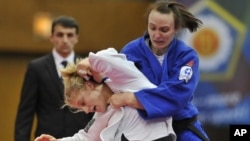
Judo, which means "gentle way" in Japanese, is a martial art created in Japan by Jigoro Kano in 1882. It was derived from the ancient techniques of jiu-jitsu. It is the most widely-practiced martial art in the world, and the second-most practiced sport worldwide behind soccer. The combat sport develops self-discipline and lays its foundation on respect for one's self and others.
Judo joins taekwondo as the only Asian martial art sports included in the Olympic Games. Men's judo debuted in the Olympics in 1964, and women's judo followed in 1992.
A judo match takes place on a mat with three referees officiating. The objective is to score an ippon, one full point, which can be achieved in four ways and immediately ends the match. One way is by pinning the opponent on the back, maintaining control of the head and shoulder for 25 seconds. Another way to win is by arm lock, applying pressure directly on the elbow of a straight arm or twisting an arm bent at a right angle until the opponent submits. A third way to win is by choke, applying pressure to the sides of the opponent's neck, but not the windpipe, until the opponent gives in. The final way to achieve an ippon is by throwing an opponent so that the landing is hard on the back.
If no ippon occurs, athletes can win by penalties or showing control over the opponent. Referees give penalties for stepping out of bounds, stalling, taunting and performing dangerous acts.
Athletes can show control by remaining on the offensive. Points are earned for waza-aris or yukos. A waza-ari, or half-point, is earned by a near-perfect throw or by holding an opponent down for 20 seconds. Two waza-aris are scored the same as an ippon and ends the match.
Yukos are lesser degrees of throws and holds and cannot end a match, no matter how many are achieved. Without an ippon or two waza-aris, Olympic judo matches last five minutes. That might not sound like a long time, but USA Judo official Ernest Pund says it can feel like "an eternity" to athletes.
Judo joins taekwondo as the only Asian martial art sports included in the Olympic Games. Men's judo debuted in the Olympics in 1964, and women's judo followed in 1992.
A judo match takes place on a mat with three referees officiating. The objective is to score an ippon, one full point, which can be achieved in four ways and immediately ends the match. One way is by pinning the opponent on the back, maintaining control of the head and shoulder for 25 seconds. Another way to win is by arm lock, applying pressure directly on the elbow of a straight arm or twisting an arm bent at a right angle until the opponent submits. A third way to win is by choke, applying pressure to the sides of the opponent's neck, but not the windpipe, until the opponent gives in. The final way to achieve an ippon is by throwing an opponent so that the landing is hard on the back.
If no ippon occurs, athletes can win by penalties or showing control over the opponent. Referees give penalties for stepping out of bounds, stalling, taunting and performing dangerous acts.
Athletes can show control by remaining on the offensive. Points are earned for waza-aris or yukos. A waza-ari, or half-point, is earned by a near-perfect throw or by holding an opponent down for 20 seconds. Two waza-aris are scored the same as an ippon and ends the match.
Yukos are lesser degrees of throws and holds and cannot end a match, no matter how many are achieved. Without an ippon or two waza-aris, Olympic judo matches last five minutes. That might not sound like a long time, but USA Judo official Ernest Pund says it can feel like "an eternity" to athletes.