


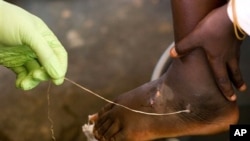
GENEVA – The World Health Organization reports Guinea Worm disease, which has plagued people for thousands of years, is on the verge of eradication.
The U.N. agency says fewer than 400 cases of the infectious parasitic disease exist in four African countries, and that it will soon become only the second, after smallpox, to be wiped off the face of the earth.
A third contender for eradication is polio.
WHO officials report 396 cases of Guinea worm disease in the first six months of this year compared to 807 cases in the same period in 2011, a dramatic decrease in incidence since the mid-1980s, which saw an estimated 3.5-million cases in 20 countries in Asia and Africa.
According to Dr. Gaitam Biswas, Guinea Worm Eradication Program team leader, the worm is now present only in Mali, Ethiopia, Chad, and newly independent South Sudan, which has an estimated 99 percent of remaining cases.
“I think the efforts are on so that we can very quickly interrupt transmission so that the world can be certified as free of the disease," he said. "When it is done, Guinea worm disease will be the first parasitic disease to be eradicated from the world, and that without any vaccine or medicine.”
A crippling parasitic disease caused by a long thread-like worm, Guinea worm is a water-borne illness transmitted via consumption of water contaminated by parasite-infected fleas.
Though rarely fatal, the disease leaves infected adults unable to work for months, and children are unable to go to school. The subsequent loss of earning power economically devastates communities.
Unlike smallpox and polio, Guinea worm has no preventative vaccine or medication to treat it. Vigilant surveillance and detection of each case, said Dr. Biswas, has been key to reducing its prevalence.
WHO officials say finding and containing the last remaining cases of the disease is the most difficult stage of the eradication process, because cases usually occur in remote, hard-to-reach areas.
“The only kind of constraint that we see is sometimes happening because of insecurities, which result in population movement from their villages or the access to the health services are problematic due to these insecurities," he said. "The difficulty in South Sudan is it is a vast country, and the resources and the terrain is very difficult to reach, so in the initial years, the surveillance had been quite challenging.”
The U.N. agency says Guinea Worm will be declared eradicated only after transmission of the disease in the affected countries has been interrupted for a minimum period of three years.
Dr. Biswas says sustained implementation of transmission control – ensuring wide access to safe drinking water and promoting health education and behavior change – is the best way to prevent infection.