


President Barack Obama is scheduled to meet Israeli Prime Minister Benjamin Netanyahu at the White House May 20. One of the topics expected to be discussed is the recent accord between Hamas and Fatah - two distinct Palestinian organizations.
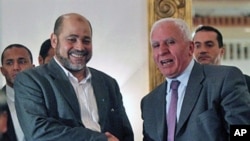
Earlier this month, the secular Fatah movement and the militant Islamic group, Hamas, signed a reconciliation pact. The agreement was brokered by the Egyptians and signed in Cairo by the leader of Fatah and president of the Palestinian Authority, Mahmoud Abbas, and Khaled Meshaal, leader of Hamas.
Among other things, the pact calls for an end to the state of war between them, the creation of an interim government and legislative and presidential elections within a year. Experts say the recent reconciliation pact is meant to heal the rift between two bitter enemies.
But many people are asking why such an agreement at this particular time?
Fawaz Gerges, a Middle East expert at the London School of Economics, says one reason is the change sweeping the Arab world.
“The pressure on the Palestinian leadership by the Palestinian public opinion has been felt. Palestinians now want their leadership - both Hamas and Fatah - to put their ideological inclinations aside and unify for the sake of the national interest, the Palestinian national interest,” Gerges said.
For his part, Alon Ben-Meir, a Middle East expert at New York University, says Hamas has realized that because of the Arab uprising, Islamism has been waning.
“The Arab youth throughout the Middle East are not demanding Islam as a way of life. They are not demanding ‘Down with Israel’ or “Down with America’ or ‘Down with This.’ They are looking for freedom, for democracy, for economic development, for opportunities, for being able to live like a human being, for having dignity. I think this message of the Arab masses was not wasted on Hamas," Ben-Meir said.
Fawaz Gerges says another reason for the Hamas/Fatah pact is what he describes as the failure of the peace process, led by the United States, in moving toward a Palestinian state.
“By gambling on American diplomacy, President Mahmoud Abbas has been undermined - his credibility and authority in the eyes of the Palestinians. This particular pact, really, represents not only the failure of American diplomacy, but also the dismal failure of President Mahmoud Abbas to deliver peace to the Palestinians. And that’s why he had no choice but to focus on putting the Palestinian house in order and beginning the healing among the Palestinian factions and groups," Gerges said.
Alon Ben-Meir says the reconciliation pact must also be seen in the light of the upcoming September vote in the United Nations General Assembly on a Palestinian state.
“The Palestinians, going back now more than six months, eight months, began to rally country by country, one after the other. And they secured roughly 130 co-sponsors to recognizing a Palestinian state based on the 1967 borders, with East Jerusalem being the capital, and the right of return for the Palestinians. This is what we call the maximalist demand. Of course it is all subject to negotiation. But demanding that in the name of Hamas and Fatah is positive in the sense that now there is a whole Palestinian body politic making the same demand," Ben-Meir said.
Ben-Meir expects the resolution to pass. But he says it is non-binding and would represent only a symbolic act. "Once they have recognition, what the heck are they going to do with it if the United States and Israel in particular do not want to cooperate? What are they going to do with it? Resort back to violence? And then what?,” Ben-Meir said.
Ben-Meir, Gerges and others believe the new Hamas/Fatah reconciliation accord could signal a turning point in the search for a lasting peace in the Middle East - but only if violence is eradicated for good.
Why Hamas/Fatah Agreement At This Juncture?