Boom or Bust: Will Expats Invest in Egypt's Economy?
People walk past a foreign currency exchange center in Cairo (file photo).
For the first time in their history, Egyptians are about to freely choose their president. While the outcome is still anybody’s guess, one thing is clear – whoever it might be, he will face the daunting task of rebuilding Egypt’s economy, which took a tremendous hit during the uprisings of last year’s Arab Spring. Egyptians living abroad, as many as 6.5 million of them, could provide a huge stimulus, but there are few indications about how deep, if at all, they are willing to reach into their pockets.
Egypt’s GDP has fallen from 7.2 percent in 2008 to a paltry 1.5 percent forecast for this year, and as many as 40% of Egyptians are now believed to be living below the poverty level. In fact, Egypt’s main share index has dropped 6.2 percent since the first-round of voting May 23-24, a sign showing investors are worried that the country might be in for further instability. The International Monetary Fund says it’s willing to consider a $3.2 billion aid package for Egypt, but only after political leaders in Cairo come up with a comprehensive economic recovery plan.
The IMF package represents a large chunk of money, but it’s considered only a drop in the bucket if held up against Egypt’s total financial needs. Many Egyptians are hoping that their country is back on the path to political stability, and that assistance and investments from abroad, including from expatriates, will soon follow.
A vendor sells cigarettes on Cairo's Tahrir Square May 25, 2012.
Meanwhile, Egypt’s General Authority for Investment (GAFI), which regulates and facilitates outside investment, has recently set up a special division of Egyptian expatriates’ affairs, to communicate with the diaspora and make it easier for Egyptians abroad to take part in the country’s development process. On its website, GAFI outlines reasons why investing in Egypt makes good sense: It has a large, skilled workforce and a large consumer market. It boasts a developed infrastructure and competitive tax rates. Its position on the world map offers it proximity to key global markets, and Egypt’s Suez Canal accommodates some 8 percent of world shipping.
Diaspora dollars
Dilip Ratha is a lead Economist and Manager of the Migration and Remittances Unit at the World Bank and a specialist on innovative financing. He says the millions of Egyptians now living outside of Egypt invest in their former homeland in two ways: through remittances to family members and friends, and, to a much lesser degree, through direct investment in the Egyptian economy itself.
To put things in perspective, remittances to Egypt have always been larger than revenue from the Suez Canal.
World Bank economist Dilip Ratha
Just how much money do Egyptian expatriates send home? According to Ratha, in 2011, even while the uprisings were taking place, the global Egyptian diaspora sent home $14 billion, double what it sent home in 2009.
“To put things in perspective, remittances to Egypt have always been larger than revenue from the Suez Canal,” Ratha said. And that, according to the expert, makes Egypt the fifth largest recipient of remittances in the world.
Studies show most Egyptians spend remittance money on household goods, but this also stimulates the greater economy. “When people buy things from the stores,” Ratha said, “that creates profit and employment. Thus, there is a multiplier effect that benefits the population in general.”
In addition, nearly 20 percent of Egyptians abroad reportedly invest money directly into the Egyptian economy, i.e., real estate, small business, agriculture, transportation, group saving schemes or industry. “With housing prices going down because of the economic and political situation, [expatriates] are taking advantage of that and sending money home to invest,” Ratha said. And he believes they would be able to do even more.
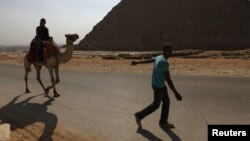
A man pulls a camel carrying a lone tourist at the Pyramids of Giza near Cairo October 19, 2011.
“We know that for every dollar [an expatriate] sends home,” Ratha explained, “it’s quite likely they save as much and more in the country of destination itself. Most of the time, they save in the form of bank deposits or cash.” By investing in Egypt’s economy through diaspora bonds or certificates, they would see an even higher return on their investment dollars, said he.
As for the roughly 80 percent of expatriates who do not invest in Egypt, the International Organization for Migration reports the largest percentage cite financial difficulty, followed by fears that investments in Egypt are too risky. A significant number say they don’t know how to invest – or where. These concerns would suggest that the onus will be on the new Egyptian government to improve the climate for investment and provide better investment advice.
Reluctant investors
Most of the Egyptian expatriates we talked to say they’re not ready to part with their savings, at least not yet. Not until the country stabilizes.
We love Egypt,...but from an economic point of view, if we want to invest, we need to see something to invest in. We need some stability.
Egyptian expatriate and US physician Wagdi Attia
Dr. Wagdi Attia is a prominent Washington, D.C., physician who emigrated to the U.S. He believes he speaks for many in the Egyptian diaspora in the United States. He recently returned from a visit to his home country and came back devastated by the state of an industry that was once a staple of Egypt’s economy – tourism. “Could you believe the pyramid area is empty of tourists? In the past, you’d stand in lines for a long time. Now, nobody was there, except camels, horses and a few people looking for business.”
”We love Egypt,” he said, “we are concerned about Egypt, we are a part of Egypt and we will never be aborted from Egypt… but from an economic point of view, if we want to invest, we need to see something to invest in. We need some stability.”We love Egypt,...but from an economic point of view, if we want to invest, we need to see something to invest in. We need some stability.
Others say it will depend on who of the two polarizing candidates currently running for the presidency actually comes to power and which, if any, changes they may bring to the country.
Dr. Tawfik Hamid, an Egyptian scholar living in Washington, D.C., says that if Islamist candidate Mohamed Morsi becomes Egypt’s next president, Islamists might be willing to invest in the country, but more liberal and Coptic Egyptians in the diaspora would be reluctant to contribute to Egypt’s economy because they wouldn’t yet know what role they might play in an Islamic-style state.
If, on the contrary… Ahmed Shafiq comes [to power], who represents the liberals, and at the same time has international experience, so he will not put the country at high risk, then many people, including myself, would be interested in making some sort of investment or contribute to it, because we would believe that a stable and enlightened Egypt could positively affect the whole area, the whole Arab world, and probably the Muslim world as well.”
Amid all the uncertainty, political and economic chaos, however, many Egyptians at home and abroad seem to communicate a sense of optimism and hope for the future. For them, Egypt has chosen democracy over dictatorship. Everything else, including the economy, they trust will eventually fall into place.