


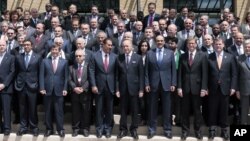
As rebels pile up victories against the Syrian Army of President Bashar al-Assad, U.S. State Department delegates will join many of the 70 member states of the Friends of the Syrian People on Wednesday in Marrakech, Morocco to offer more support for the overthrow of Assad and to shorten a bloody 20-month revolution.
Recent rebel Free Syrian Army successes have been telling: downing Syrian MiG jets and helicopter gunships with shoulder-fired air defense missiles, forcing the government to temporarily shut down commercial flights to Damascus International Airport, and taking and holding urban and as well rural regions in the northern governorates of Idlib and Aleppo - Syria’s wealthy commercial and manufacturing center.
Some of the rebel advances – such as Monday’s takeover of a large Syrian Arab Army (SAA) base near Aleppo - have been led by better-equipped jihadist groups such as Jabhat al-Nusra, which Washington placed Tuesday morning on its terrorism list as an alias for al-Qaida in Iraq. The announcement marks an effort by the United States to isolate or remove extremists fighting units from rebel forces that may receive support from Friends of Syria.
Most of Syria’s armed opposition groups – poorly equipped local volunteers and SAA defectors – have asked for substantial military support from Western nations, specifically, enforcement of a no-fly zone in the north and delivery of heavier weapons than their AK-47 assault rifles.
Their pleas for heavy weapons was echoed by the Syrian National Council, exiles who shared their desire for regime change, but failed early on to ignite global support. Now strengthened by creation of the Syrian National Coalition of Revolution and Opposition Forces, Assad’s political opponents hope to come away from Marrakech with pledges of enough military support to take Damascus, the capital, and to shorten a war many predict could go on for another six months or longer.
But will there be weapons?
In recent days, reports of unity among domestic anti-Assad forces took root: On Thursday, 96 representatives of revolutionary councils met in Istanbul and the next day commanders of 30 military councils agreed to form a united Syria Military Council under a chief of staff, Gen. Salim Idriss. The council does not include Jabhat al-Nusra, which was not invited to the Antalya meeting.
International support for the opposition also is growing. NATO committed to install Patriot missiles on the Turkish side of Syria’s northern border, the U.S. pointedly warned Assad against using chemical weapons on Syrians, and there were reports that France is handing out cash to local political councils inside Syria through its new representatives in the coalition.
At the NATO meeting in Brussels, U.S. Secretary of State Hillary Clinton – who had to cancel her Marrakech plans due to illness - said, “Now that there is a new opposition formed, we are going to do what we can to support that opposition.”
However, the meeting in Morocco Wednesday may only give more moral support and added humanitarian aid. Sources say it may be too soon to expect substantial military promises. Deputy Secretary of State Robert Burns will lead the U.S. delegation to Marrakech.
The United States, a major player in the Friends of Syria, is said to be impressed with endorsements of the coalition by domestic opposition leaders, but needs evidence of popular support from the street activists. Officials hope that will develop over time.
Following the birth of the broader National Coalition in Doha under the leadership of moderate Sunni cleric Mouaz al-Khatib, France, the United Kingdom and Germany, recognized the Syrian National Coalition as Syria’s government in exile. Washington, however, says the coalition’s role is at this point only that of the leader of a revolution.
Washington also does not appear ready to commit to a no-fly zone that requires significant military support. Officials indicate instead that the meeting in Marrakech will emphasize basic issues such as food, medicine and fuel for the thousands of Syrians in informal refugee camps that have sprung up in rebel-occupied territories.
To date, the U.S. government has given over $200 million in what officials describe as humanitarian aid to improve living conditions for refugees and others displaced internally by the war.
Washington avoids discussion of significant military commitments because officials don’t want U.S. weapons going to those whose goals extend beyond restoration of a peaceful, democratic and secular Syria. And officials point out that rebel forces are already achieving success in some areas with weapons provided by other sources.
“The military is still fragmented, but they are able to take down the regime and they are doing it piece by piece,” said Andrew Tabler of the Washington Institute for Near East Policy and author of “In the Lion’s Den: An Eyewitness Account of Washington’s Battle with Syria.” But Tabler worries about what those fighting units will do after Assad is gone.
“The problem the rebels face is whether these diverse fighting units will merge when it comes time to rule,” Tabler said. “And most important, the United States has no relations with them at all.”
Doubts about opposition unity
Tabler argued in a recent VOA interview, “I think predictions of the unity of the opposition are overstated.” He said there are two weaknesses in the new coalition’s appeal.
First, the opposition that coalesced in Doha still needs better links with opposition leadership inside Syria. The Khatib coalition chose activists in Syria to represent the 14 revolutionary councils, but Tabler said the activists may not adequately represent those councils.
“The question is how much sway do they have in their governorates. It’s a bit strange… For example, in Homs, you have an active revolutionary council but the revolutionary council in Homs is not really represented. There is a local notable who is represented from Homs.”
The second weakness cited by Tabler is that the coalition’s goal to reduce the dominating influences of the Syrian National Council’s Muslim Brotherhood faction was not achieved. “The SNC is still a major player,” he said, and remains ”a dysfunctional organization.” And he worries whether the coalition will be able to maintain control.
“And that’s just the civil end. The armed groups within the country are not included in this coalition directly. How is that going to work?”
Recent rebel Free Syrian Army successes have been telling: downing Syrian MiG jets and helicopter gunships with shoulder-fired air defense missiles, forcing the government to temporarily shut down commercial flights to Damascus International Airport, and taking and holding urban and as well rural regions in the northern governorates of Idlib and Aleppo - Syria’s wealthy commercial and manufacturing center.
Some of the rebel advances – such as Monday’s takeover of a large Syrian Arab Army (SAA) base near Aleppo - have been led by better-equipped jihadist groups such as Jabhat al-Nusra, which Washington placed Tuesday morning on its terrorism list as an alias for al-Qaida in Iraq. The announcement marks an effort by the United States to isolate or remove extremists fighting units from rebel forces that may receive support from Friends of Syria.
Most of Syria’s armed opposition groups – poorly equipped local volunteers and SAA defectors – have asked for substantial military support from Western nations, specifically, enforcement of a no-fly zone in the north and delivery of heavier weapons than their AK-47 assault rifles.
Now that there is a new opposition formed, we are going to do what we can to support that opposition - Secretary of State Hillary Clinton
But will there be weapons?
In recent days, reports of unity among domestic anti-Assad forces took root: On Thursday, 96 representatives of revolutionary councils met in Istanbul and the next day commanders of 30 military councils agreed to form a united Syria Military Council under a chief of staff, Gen. Salim Idriss. The council does not include Jabhat al-Nusra, which was not invited to the Antalya meeting.
International support for the opposition also is growing. NATO committed to install Patriot missiles on the Turkish side of Syria’s northern border, the U.S. pointedly warned Assad against using chemical weapons on Syrians, and there were reports that France is handing out cash to local political councils inside Syria through its new representatives in the coalition.
At the NATO meeting in Brussels, U.S. Secretary of State Hillary Clinton – who had to cancel her Marrakech plans due to illness - said, “Now that there is a new opposition formed, we are going to do what we can to support that opposition.”
However, the meeting in Morocco Wednesday may only give more moral support and added humanitarian aid. Sources say it may be too soon to expect substantial military promises. Deputy Secretary of State Robert Burns will lead the U.S. delegation to Marrakech.
The United States, a major player in the Friends of Syria, is said to be impressed with endorsements of the coalition by domestic opposition leaders, but needs evidence of popular support from the street activists. Officials hope that will develop over time.
Following the birth of the broader National Coalition in Doha under the leadership of moderate Sunni cleric Mouaz al-Khatib, France, the United Kingdom and Germany, recognized the Syrian National Coalition as Syria’s government in exile. Washington, however, says the coalition’s role is at this point only that of the leader of a revolution.
The military is still fragmented, but they are able to take down the regime and they are doing it piece by piece - Andrew Tabler, Washington Institute
To date, the U.S. government has given over $200 million in what officials describe as humanitarian aid to improve living conditions for refugees and others displaced internally by the war.
Washington avoids discussion of significant military commitments because officials don’t want U.S. weapons going to those whose goals extend beyond restoration of a peaceful, democratic and secular Syria. And officials point out that rebel forces are already achieving success in some areas with weapons provided by other sources.
“The military is still fragmented, but they are able to take down the regime and they are doing it piece by piece,” said Andrew Tabler of the Washington Institute for Near East Policy and author of “In the Lion’s Den: An Eyewitness Account of Washington’s Battle with Syria.” But Tabler worries about what those fighting units will do after Assad is gone.
“The problem the rebels face is whether these diverse fighting units will merge when it comes time to rule,” Tabler said. “And most important, the United States has no relations with them at all.”
Doubts about opposition unity
Tabler argued in a recent VOA interview, “I think predictions of the unity of the opposition are overstated.” He said there are two weaknesses in the new coalition’s appeal.
First, the opposition that coalesced in Doha still needs better links with opposition leadership inside Syria. The Khatib coalition chose activists in Syria to represent the 14 revolutionary councils, but Tabler said the activists may not adequately represent those councils.
“The question is how much sway do they have in their governorates. It’s a bit strange… For example, in Homs, you have an active revolutionary council but the revolutionary council in Homs is not really represented. There is a local notable who is represented from Homs.”
The second weakness cited by Tabler is that the coalition’s goal to reduce the dominating influences of the Syrian National Council’s Muslim Brotherhood faction was not achieved. “The SNC is still a major player,” he said, and remains ”a dysfunctional organization.” And he worries whether the coalition will be able to maintain control.
“And that’s just the civil end. The armed groups within the country are not included in this coalition directly. How is that going to work?”