



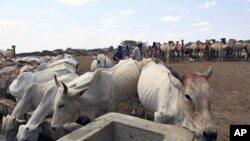
The World Bank Friday unveiled new details of its plan to help victims of drought in the Horn of Africa. The bulk of the effort focuses on Ethiopia and Kenya, not Somalia.
The bank's Country Director for East Africa Johannes Zutt says over $600 million is being made available to those affected by the drought in Somalia, Ethiopia and Kenya.
But only $9 million is going directly toward disaster relief in Somalia, the worst hit country in East Africa.
Zutt says the problem is access.
“As you all know, the fragility in Somalia, where the drought is at its worst and where famine has already been declared in Bakoool and Lower Shabelle, that fragility makes it difficult to respond to the situation because humanitarian agencies and development partners have limited access,” said Zutt.
The money for Somalia will be used to help communities at the heart of the famine, through programs implemented by the United Nations Food and Agriculture Organization.
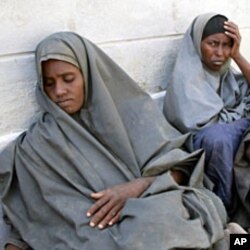
But the bulk of World Bank funds are going to be doled out over three years to Kenya and Ethiopia, which are also experiencing drought.
The World Bank has a long history in Ethiopia, and, with other donors, has contributed $850 million to a so-called “safety nets” project in the country that now covers over 7.5 million people.
Zutt says the Bank is adding funds to that project and a similar one in Kenya.
“Those social safety nets are not intended to be a complete substitute for the livelihoods of people affected by drought," said Zutt. "They are merely intended to supplement the incomes of people who are affected, and both in Kenya and Ethiopia we have seen very large numbers of very poor people who are just on the edge of extreme vulnerability.”
Most of the World Bank's efforts are focused on medium and long-term projects. Of the emergency funding announced, $267 million is going toward economic recovery over the next two years.
Another $330 million is for drought resilience programs, such as investment in agriculture and water projects.
The clear message from the World Bank is that droughts will continue to be a part of life in East Africa.
“The Horn of Africa faces recurring droughts, but climate change is making them more intense. In the longer term, it's important for the countries of the Horn to prepare for recurring droughts," said Zutt. "All climate models agree that temperatures in the Horn of Africa will increase by one to three-and-a-half degrees Celsius over the coming decades.”
Food production and sustainable agriculture is a key part of the World Bank's initiatives, as recurring droughts have significantly raised the cost of food.
The World Bank says since 2010 rising food prices have pushed 44 million people into poverty and says a further 10 percent increase could impact another 10 million.