VIDEO: Group of 20 cleaved down the middle Friday on question of supporting U.S. in push for strikes against the Syria’s government.
ST. PETERSBURG, RUSSIA —
The Group of 20 split down the middle Friday on the question of supporting the United States in punishing Syria’s government for apparently gassing civilians two weeks ago in Damascus.
As the G-20 meeting ended in St. Petersburg, the White House released a statement endorsed by U.S. President Barack Obama and 10 other world leaders. It said: “The world cannot wait for endless failed processes that can only lead to increased suffering in Syria and regional instability. We support efforts undertaken by the United States and other countries to reinforce the prohibition on the use of chemical weapons.”
Obama said his next step will be to appeal directly to the American people in a televised address from the White House on Tuesday. The U.S. president is seeking approval from the U.S. Congress for air strikes against Syria’s military.
In Russia, he said the world cannot stand by while weapons of mass destruction are used against civilians.
“Failing to respond to this breach of this international norm would send a signal to rogue nations, authoritarian regimes and terrorist organizations that they can use W.M.D. and not pay a consequence - and that’s not a world we want to live in,” the American president told reporters.
Making a case
The statement backing U.S. action was endorsed by the leaders of Australia, Britain, Canada, France, Italy, Japan, South Korea, Saudi Arabia, Spain, and Turkey.
During his 24 hours in St. Petersburg, the American president stressed that military action will be limited to punishing the government of Syrian President Bashar al-Assad for gassing civilians.
“Gassing innocent people, delivering chemical weapons against children, is not something we do,” he said at the press conference. “It’s prohibited in active wars between countries, even more so against children, and we’ve got to stand up for that principle.”
Obama repeatedly refused to say whether he would order air attacks against Syria if Congress does not vote to authorize use of military force.
In St. Petersburg, the American president repeatedly was countered by Russian President Vladimir Putin - in a 20-minute one-on-one meeting Thursday night, and at group meetings of the world leaders.
Putin presses point
At Putin’s press conference, he listed the countries that supported his position of non-interference.
“Who was categorically against?” he asked. “Russia, China, India, Indonesia - I draw your attention, the largest Muslim country in the world in terms of population - Argentina, Brazil, South Africa.”
While several countries are against U.S. action, the Russian president also took what are increasingly minority positions: casting doubt that chemical weapons were used and saying that, if they were, it was opposition fighters who used them.
“I assume that everything that happened with the so-called chemical weapons, is a provocation by the fighters, who are counting on to their side, on the help of those countries who from the beginning supported them,” said Putin. “That's the whole point of this provocation.”
A reporter asked the Russian president if Russia would send military aid to Syria in the event of an attack by the United States.
“Are we going to help Syria?” asked Putin. “We will. The way we now help. We supply weapons, we cooperate in the economic sphere. I hope there will be more cooperation in the humanitarian sphere.”
Russia's reprisals
Earlier in the week, the Russian leader suggested that if the United States attacks, the Kremlin would consider completing delivery of sophisticated S-300 air-defense missiles to Syria.
Russia’s support of Syria’s government is so rock solid, that the Obama administration has little hope of winning support in the United Nations Security Council.
Russia has vetoed three Syria resolutions in the Security Council. On Thursday, U.S. Ambassador to the United Nations Samantha Power said: "Russia continues to hold the Council hostage and shirk its responsibility."
With the world divided and congressional support in doubt, the American president seems to face an uphill battle to forge ahead with air strikes.
The G20 Summit
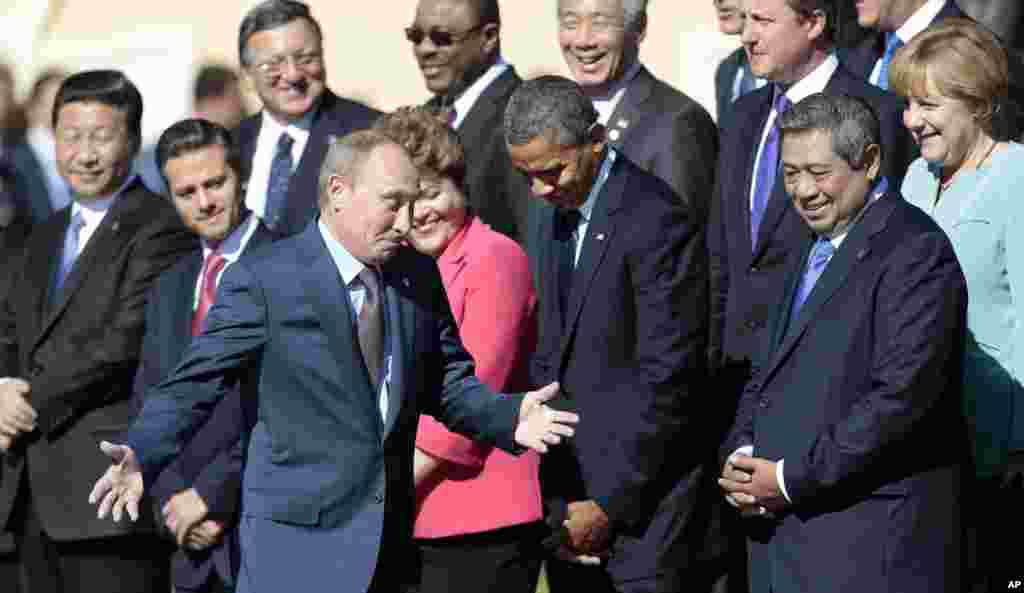
1/11Russia's President Vladimir Putin, center foreground, gestures as he walks by U.S. President Barack Obama, front row second right, as he takes his place at a group photo outside of the Konstantin Palace in St. Petersburg, Russia, Sept. 6, 2013.
Show moreShow less
2/11U.S. President Barack Obama, right, walks with Germany's Chancellor Angela Merkel prior to a group photo of G-20 leaders outside of the Konstantin Palace in St. Petersburg, Russia, Sept. 6, 2013.
Show moreShow less
3/11An image of U.S. President Barack Obama drinking out of a paper cup is shown on a large screen in the media center of a G-20 summit in St. Petersburg, Russia, Sept. 6, 2013.
Show moreShow less
4/11British Prime Minister David Cameron speaks during a media conference after a G-20 summit in St. Petersburg, Russia on Friday, Sept. 6, 2013.
Show moreShow less
5/11Russian President Vladimir Putin (C) arrives for the family picture event during the G20 summit in St. Petersburg, Sept. 6, 2013.
Show moreShow less
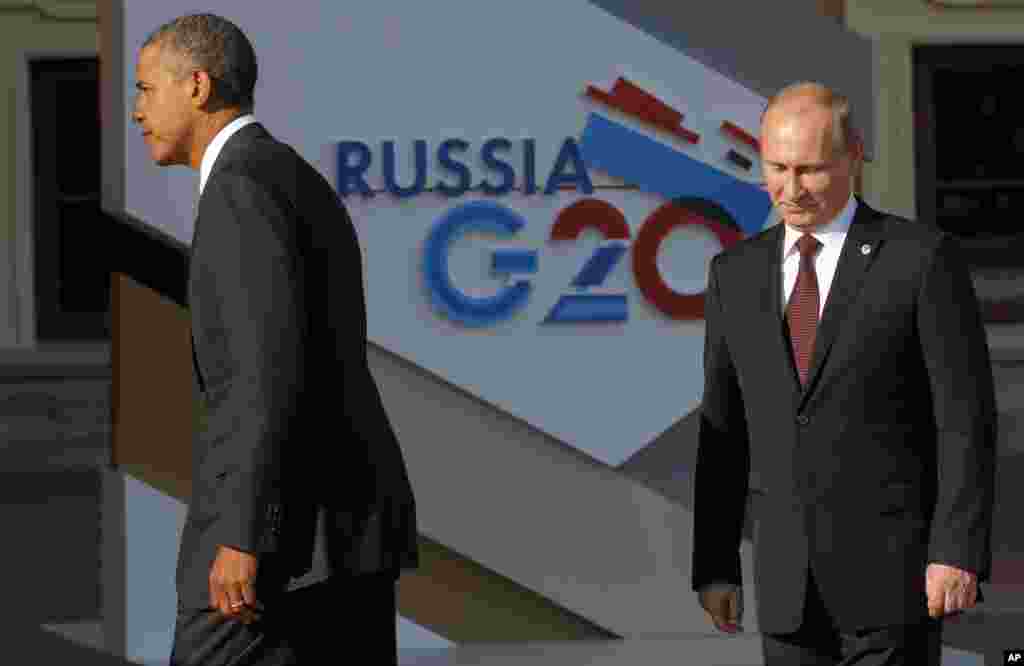
6/11U.S. President Barack Obama walks away after shaking hands with Russia's President Vladimir Putin during arrivals for the G20 Summit at the Konstantin Palace in St. Petersburg, Sept. 5, 2013.
Show moreShow less
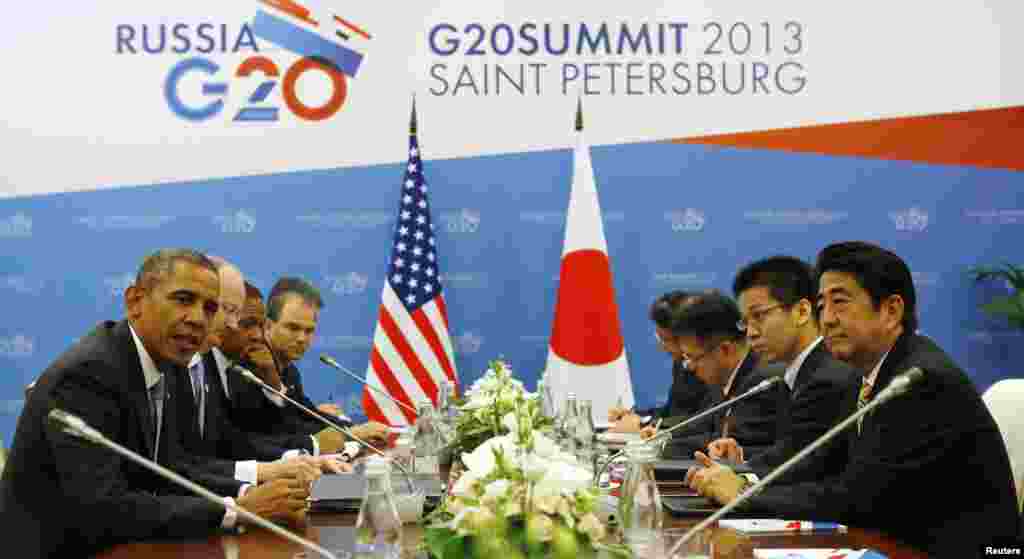
7/11U.S. President Barack Obama meets with Japanese Prime Minister Shinzo Abe at the G20 Summit in St. Petersburg, Sept. 5, 2013.
Show moreShow less
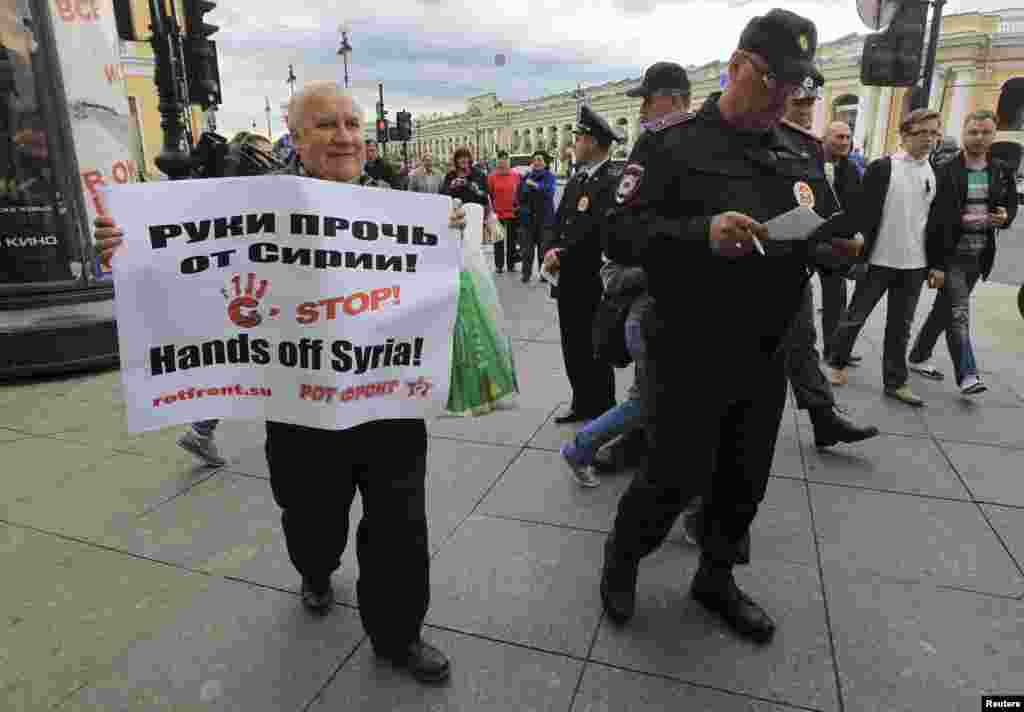
8/11A man protests possible military action in Syria as the first day of the G20 Summit gets underway in St. Petersburg, Sept. 5, 2013.
Show moreShow less
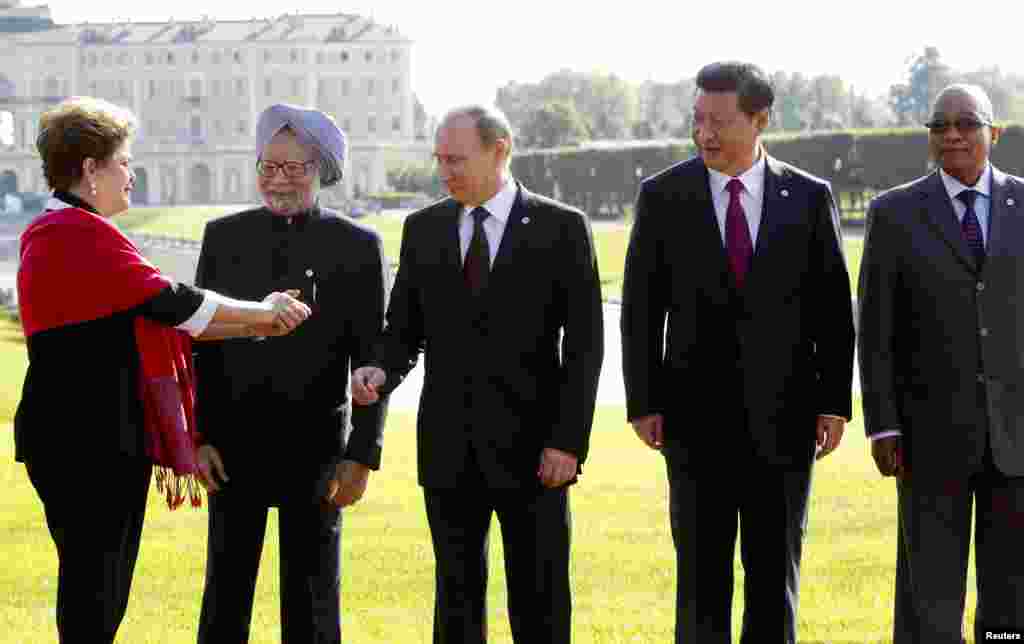
9/11BRICS leaders' at the G20 Summit in Strelna near St. Petersburg, Sept. 5, 2013.
Show moreShow less
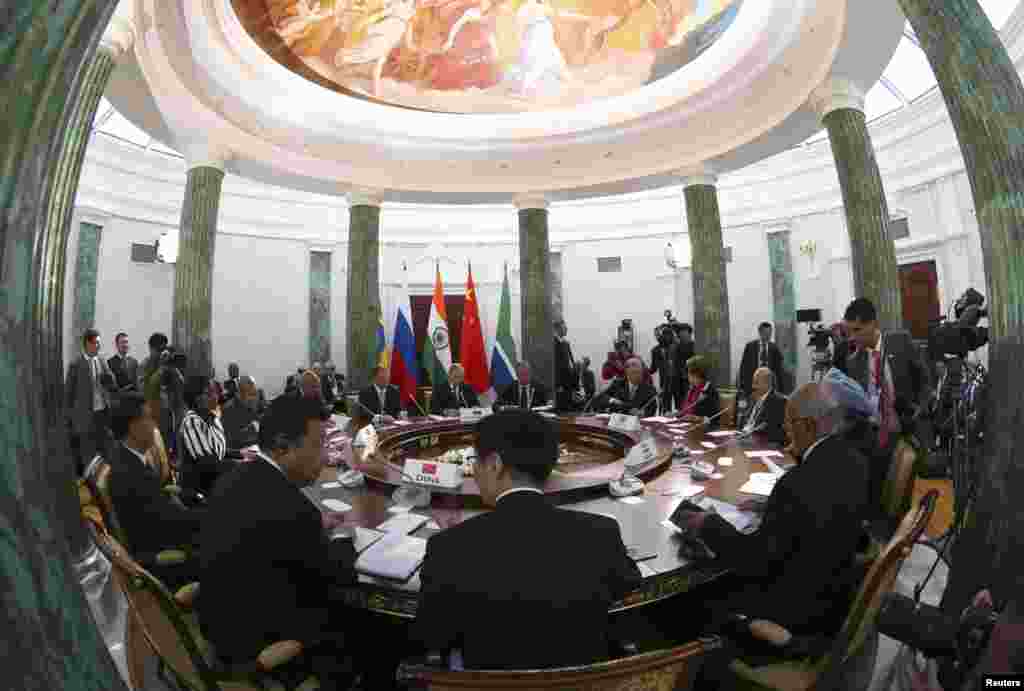
10/11Participants sit at a table during a BRICS leaders' meeting at the G20 Summit in Strelna near St. Petersburg, Sept. 5, 2013.
Show moreShow less
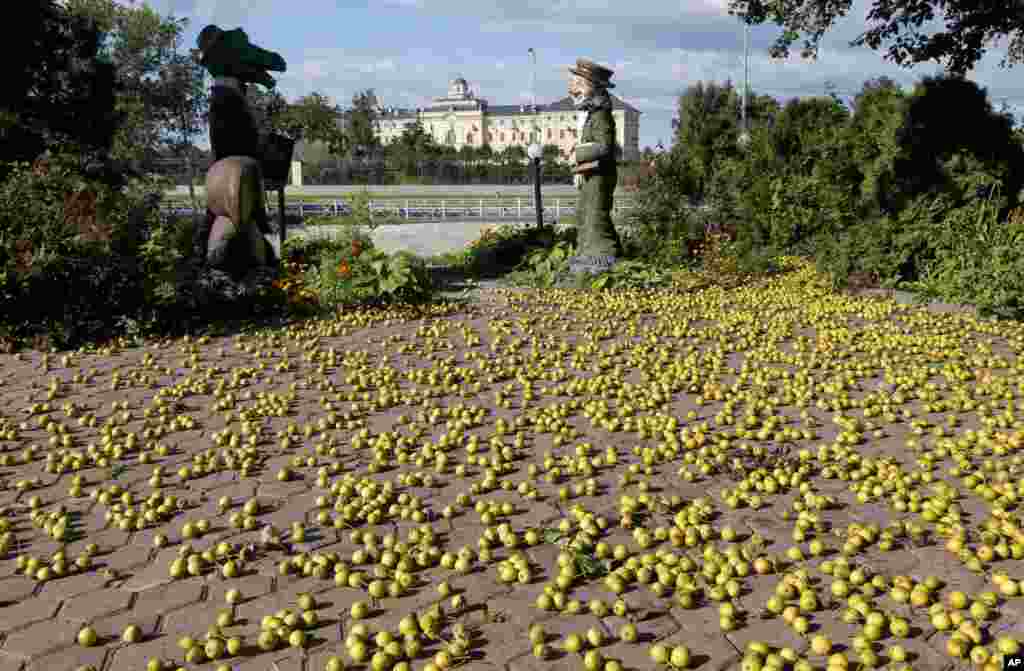
11/11Apples are seen on the ground next to statues across the street from the Constantine Palace, the venue for a G20 meeting in St. Petersburg, Sept. 4, 2013.